




Multimedia Gallery
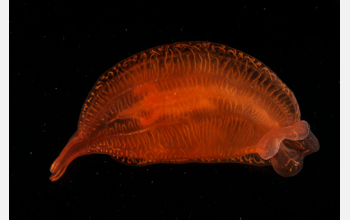

Jellies Reveal Evolutionary History (Image 2)
Jellies Reveal Evolutionary History (Image 2)
The comb jelly Aulicoctena, a deep-sea species that was collected using a remotely operated underwater vehicle by the Monterey Bay Aquarium Research Institute.
A National Science Foundation-supported study has defined the earliest splits at the base of the animal tree of life, a hierarchical representation of the evolutionary relationships between species that was introduced by Charles Darwin. Results of the study suggest that the comb jelly, which has tissues and a nervous system, split off from other animals before the tissue-less, nerve-less sponge--a finding that challenges the traditional view of the base of the tree of life, which placed the sponge as the earliest diverging animal.
The presence of the relatively complex comb jelly at the base of the "tree" suggests that the first animal was probably more complex than previously believed, says Casey Dunn of Brown University, who led the study.
While Dunn cautions that additional studies will be needed to corroborate his team's findings, he says that the comb jelly could only have achieved its apparent seniority over the simpler sponge through one of two new evolutionary scenarios: 1) the comb jelly evolved its complexity independently of other animals, after it branched off onto its own evolutionary path; or 2) the sponge evolved its simple form from more complex creatures. [Research supported by NSF grants DEB 04-08014, DEB 03-34932 and DEB 05-31757.]
To read more about Dunn's research, see the NSF Press Release, "And the First Animal on Earth Was a ..."
To learn more about the basics of jellyfish biology, what scientists have learned thus far about the worldwide increase in jellyfish populations, and the causes of jellyfish swarms and how they affect both human and marine life, see the NSF Special Report, "Jellyfish Gone Wild!" (Date of Image: 2005) [See related image Here.]
Credit: Casey Dunn, Brown University
Special Restrictions: The owner has restricted the use of this image. To find out what restrictions apply, refer to the "Open Content License" on the Creative Commons and Share alike 3.0 United States License Agreement.
Images and other media in the National Science Foundation Multimedia Gallery are available for use in print and electronic material by NSF employees, members of the media, university staff, teachers and the general public. All media in the gallery are intended for personal, educational and nonprofit/non-commercial use only.
Images credited to the National Science Foundation, a federal agency, are in the public domain. The images were created by employees of the United States Government as part of their official duties or prepared by contractors as "works for hire" for NSF. You may freely use NSF-credited images and, at your discretion, credit NSF with a "Courtesy: National Science Foundation" notation.
Additional information about general usage can be found in Conditions.
Also Available:
Download the high-resolution JPG version of the image. (255 KB)
Use your mouse to right-click (Mac users may need to Ctrl-click) the link above and choose the option that will save the file or target to your computer.