




All Images
News Release 10-174
New Study Validates Factors That Enhance the Intelligence of a Group
Tendency to cooperate effectively is linked to the number of women in a group
This material is available primarily for archival purposes. Telephone numbers or other contact information may be out of date; please see current contact information at media contacts.

A team working on one of the tasks used in the study. Teams were asked to assemble complicated Lego® structures based on detailed instructions. Teams were randomly assembled by soliciting participation via Craig's List.
Credit: MIT
Download the high-resolution JPG version of the image. (767 KB)
Use your mouse to right-click (Mac users may need to Ctrl-click) the link above and choose the option that will save the file or target to your computer.

View a video of Thomas Malone's presentation to the IdeasLab at the World Economic Forum in Davos, Switzerland, January 2010.
Credit: World Economic Forum (WEF)
Anita Williams Woolley, Science paper first author and Carnegie Mellon University's Tepper School of Business associate professor, describes the study's findings.
Credit: CMU
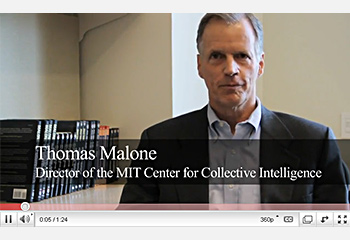
View a video of Thomas W. Malone, study co-author, MIT's Center for Collective Intelligence founding director, and Sloan business professor, putting the group's research into context.
Credit: MIT

Anita Williams Woolley, the paper's lead author and assistant professor of organizational behavior & theory at the Tepper School of Business, Carnegie Mellon University.
Credit: Anita Williams Woolley, Tepper School of Business, Carnegie Mellon University.
Download the high-resolution JPG version of the image. (3.2 MB)
Use your mouse to right-click (Mac users may need to Ctrl-click) the link above and choose the option that will save the file or target to your computer.

Thomas W. Malone is the Patrick J. McGovern Professor of Management at the MIT Sloan School of Management and the founding director of the MIT Center for Collective Intelligence. He was also the founding director of the MIT Center for Coordination Science and one of the two founding co-directors of the MIT Initiative on &dquo;Inventing the Organizations of the 21st Century&dquo;. Professor Malone teaches classes on leadership and information technology, and his research focuses on how new organizations can be designed to take advantage of the possibilities provided by information technology.
Credit: Patrick Gillooly, MIT
Download the high-resolution JPG version of the image. (3 MB)
Use your mouse to right-click (Mac users may need to Ctrl-click) the link above and choose the option that will save the file or target to your computer.

Christopher F. Chabris, co-author on the paper, is an assistant professor of psychology at Union College and Adjunction Assistant Professor of Neurology at the Albany Medical College.
Credit: Christopher F. Chabris, Union College
Download the high-resolution JPG version of the image. (172 KB)
Use your mouse to right-click (Mac users may need to Ctrl-click) the link above and choose the option that will save the file or target to your computer.