





All Images
News Release 11-226
Manufacturing Goes Viral
Researchers coax viruses to assemble into synthetics with microstructures and properties akin to those of corneas, teeth and skin
This material is available primarily for archival purposes. Telephone numbers or other contact information may be out of date; please see current contact information at media contacts.

This illustration reveals how the arrangement of molecular building blocks results in materials with unique properties, both in nature and in the laboratory.
Credit: Zina Deretsky, National Science Foundation
Download the high-resolution JPG version of the image. (568 KB)
Use your mouse to right-click (Mac users may need to Ctrl-click) the link above and choose the option that will save the file or target to your computer.
In this NSF webcast, University of California at Berkeley bioengineer Seung-Wuk Lee describes how his team developed a new way to rapidly and efficiently manufacture novel nanomaterials using viruses as the building blocks.
Credit: National Science Foundation
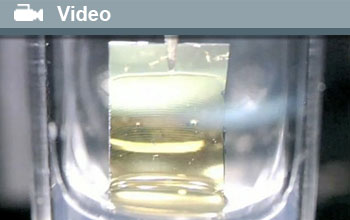
View a video showing a new process using viruses to assemble collagen-like materials.
Credit: Video by Woo-Jae Chung, UC Berkeley
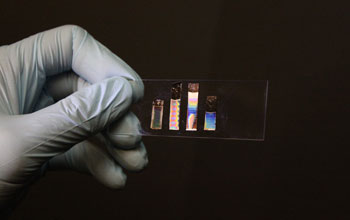
Tiny patches of the new virus-based materials reveal different textures and different properties for reflecting light.
Credit: University of California at Berkeley
Download the high-resolution JPG version of the image. (5.4 MB)
Use your mouse to right-click (Mac users may need to Ctrl-click) the link above and choose the option that will save the file or target to your computer.
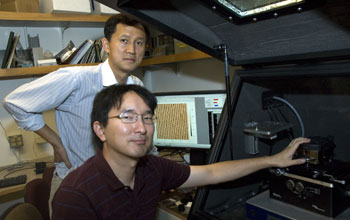
Seung-Wuk Lee and Woojae Chung, both of the University of California at Berkeley, use an atomic force microscope to analyze the ramen-noddle-like nanostructure fabricated through a self-templated materials assembly process of viral particles.
Credit: University of California at Berkeley
Download the high-resolution JPG version of the image. (1.7 MB)
Use your mouse to right-click (Mac users may need to Ctrl-click) the link above and choose the option that will save the file or target to your computer.