



News Release 09-231
Ice Cold: Cooler Than Being Cool
Researchers isolate new type of antifreeze molecule from freeze-tolerant beetle
November 23, 2009
This material is available primarily for archival purposes. Telephone numbers or other contact information may be out of date; please see current contact information at media contacts.
Water expands when it freezes. Anyone who has ever left a can of soda or bottle of water in the freezer too long has witnessed this first hand. So how do plants and animals survive severe temperatures?
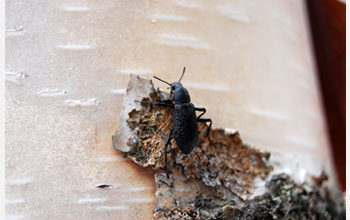
Insects exposed to subzero temperatures can adapt to the extreme climate to survive freezing temperatures, but until now, antifreeze molecules had not been isolated from freeze-tolerant animals. The NSF-supported study, published in the November 24 issue of Proceedings of the National Academy of Sciences, describes a brand new type of antifreeze molecule isolated from a freeze-tolerant Alaskan beetle by Kent Walters and colleagues at the University of Notre Dame.
Interestingly, the antifreeze molecule described by the research team differs from previously described factors in that it is not a protein, but a combination of saccharides and fatty acids, which are other types of biomolecules. What does that mean? Size is one big difference. The exact size of this particular molecule is unknown, but the fact that it is small could prove beneficial. The chemical composition of the molecule could prove amenable to commercial production because small chains of sugars can be readily synthesized in the laboratory, making them cheaper and easier to manufacture than biologically assembled molecules.
Antifreeze molecules are present in many organisms including fish, insects, plants, fungi and bacteria. "The most active known antifreeze proteins had been described in freeze-avoiding insects, allowing certain insects to survive temperatures below -60 C (-76 F)" said Walters. However, this is the first reported isolation of antifreeze from a freeze-tolerant insect (those able to survive freezing).
One reason is that the antifreeze molecules are not always present. Dropping temperatures serve as a signal that the insects respond to by activating a host of adaptive responses including expression of antifreeze molecules. Researchers can artificially stimulate this response by conditioning the insects before they perform experiments.
Current methods used to cryopreserve tissues result in low viability after thaw, in part because existing solutes must be used at concentrations that are often toxic to cells or tissues. Because the new antifreeze molecule exhibits activity at relatively low concentrations in insects, it is possible researchers may be able to use them at low concentrations in the lab too.
According to Walters, "Potential applications for this new class of antifreeze molecules are abundant. In terms of cryopreservation, we may be able to increase viability and enhance survivorship of cells and tissues from other organisms under freezing conditions."
-NSF-
Media Contacts
Lisa Van Pay, NSF, (703) 292-8796, email: lvanpay@nsf.gov
Co-Investigators
Kent Walters, University of Notre Dame, (574) 631-5495, email: kwalter2@nd.edu
The U.S. National Science Foundation propels the nation forward by advancing fundamental research in all fields of science and engineering. NSF supports research and people by providing facilities, instruments and funding to support their ingenuity and sustain the U.S. as a global leader in research and innovation. With a fiscal year 2023 budget of $9.5 billion, NSF funds reach all 50 states through grants to nearly 2,000 colleges, universities and institutions. Each year, NSF receives more than 40,000 competitive proposals and makes about 11,000 new awards. Those awards include support for cooperative research with industry, Arctic and Antarctic research and operations, and U.S. participation in international scientific efforts.

Connect with us online
NSF website: nsf.gov
NSF News: nsf.gov/news
For News Media: nsf.gov/news/newsroom
Statistics: nsf.gov/statistics/
Awards database: nsf.gov/awardsearch/
Follow us on social
Twitter: twitter.com/NSF
Facebook: facebook.com/US.NSF
Instagram: instagram.com/nsfgov