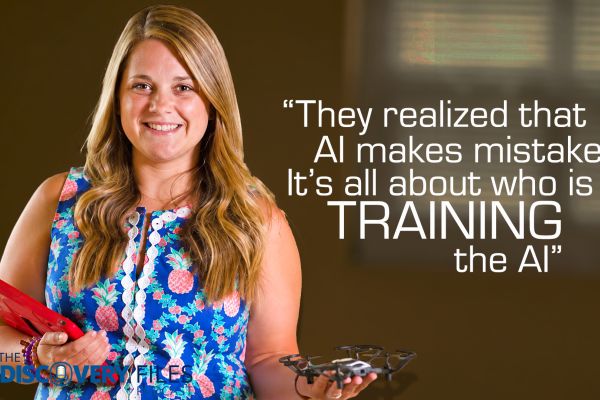
University of Minnesota Duluth Chancellor Lendley Black talks on the importance of the Ojibwe language revitalization program and the role of technology in helping to promote greater understanding of American Indian life and culture. View the video interview above or download the video. Credit: Marsha Walton, Science Nation, National Science Foundation
University of Minnesota Duluth education professor Mary Hermes (left) works with Ruby Boshey to transcribe a short movie in Ojibwe. Once the movies are transcribed, they are combined with vocabulary lists, pronunciations, and interactive games to create educational DVDs.
Credit: Science Nation, National Science Foundation
For over a century, the language of the Wampanoag tribes was not spoken. A crucial part of the tribes' culture was lost. A new documentary, "We Still Live Here--Âs Nutayuneân," tells the story of how Jessie Little Doe Baird and members of the Wôpanâak Language Reclamation Project brought this language back to life. Learn more about this film that is Now Showing.
Credit: Courtesy of Cultural Survival
The National Endowment for the Humanities (NEH) and NSF announced the award of 10 fellowships and 24 institutional grants totaling $3.9 million in the agencies' ongoing Documenting Endangered Languages (DEL) program. This is the seventh round of their campaign to preserve records of languages threatened with extinction. Find out more in this news release.
Credit: Nicolle Rager Fuller, National Science Foundation
"Hand talk" or "sign talk," as shown in this still image from a 1930s video, has been used by both deaf and hearing Indians from Canada to the Gulf of Mexico for at least 200 years. Today, sign language scholars Jeffrey Davis and Melanie McKay-Cody are working with others to document and preserve hand talk, one of thousands of the world's endangered languages. Learn more in this Science Nation video.
Credit: Science Nation, National Science Foundation
As "globalization" increases, so does the loss of human languages. People find it easier to conduct business and communicate with those outside their own culture if they speak more widely used languages like Chinese, Hindi, English, Spanish or Russian. As fewer people use local languages, they gradually die out. Documentation is the key to preserving endangered languages. Learn more in this Special Report.
Credit: Bonny Sands, Northern Arizona University
The Division of Behavioral and Cognitive Sciences (BCS) of the Directorate for Social, Behavioral and Economic Sciences supports research to develop and advance scientific knowledge on human cognition, language, social behavior and culture, as well as research on the interactions between human societies and the physical environment.
David W. Lightfoot discusses how and why languages live and die. Even as languages are dying in unprecedented numbers, new languages are constantly emerging as existing ones diverge into different form.
November 21, 2011
New Home Movies Resurrect Endangered American Indian Language
Educator develops multimedia tools to share Ojibwe language and culture
University of Minnesota Duluth education professor Mary Hermes says saving an endangered language goes beyond just enriching the people who speak it.
"I think people have got to get beyond thinking it's just for the Ojibwe people, that we want to save their Ojibwe language. There's 10,000 years of human evolution and knowledge in that language," she says.
With support from the National Science Foundation (NSF), Hermes is combining the skills of native speakers with video technology to help others, young and old, learn the language in the most natural way. She's doing it by videotaping short movies of everyday situations, from going to a rummage sale to planting a garden to helping out a sick relative.
"Because Ojibwe isn't spoken on a regular basis, there's not a store or a rummage sale or a resort, but part of what we're doing is trying to re-envision what that would be like," explains Hermes.
"So imagine if Ojibwe was the language of commerce, the language of everywhere you went; everything you did was in Ojibwe," she says.
"What we are hoping is that you hear it in an everyday way, [with phrases like] 'tie your shoes,' 'get up,' 'hey mom what's for breakfast,'--that kind of informal speaking ... that's not necessarily correct formal grammar, but the way you would speak it," she says.
Once those short movies are transcribed by native speakers, they are combined with vocabulary lists, pronunciations, and interactive games to create educational DVDs.
Whether it is adults who may have forgotten the language they spoke as children, or young people who want to learn more about their culture, Hermes says these DVDs can be motivational.
"People have such a fear of speaking when they are adults," she says. "They don't want to sound stupid or offend somebody. So for some people it's comforting to practice and then get the courage to go talk to somebody."
Besides the videos, Hermes has worked to create immersion schools for the language and helped arrange workshops to boost interest in Ojibwe, and other endangered languages.
"I started a nonprofit called Grass Roots Indigenous Multimedia, specifically to distribute the multimedia products we've made. So this small nonprofit has reached out with the tools we have, to share to other tribes," she says.
"Now I go places, and I'm meeting new people, new young people who can actually have a conversation with me. And that makes me feel like, OK, it took 10 years, but there's definitely progress here," says Hermes.
One of Hermes' "movie stars" is Ruby Boshey, who has also taught the Ojibwe language. But, through much of her childhood, Boshey was punished for speaking her native tongue.
"When I was five years old, the priests came and picked us up from my reservation on Lac La Croix, Ontario. I'd never heard an English word before then, and they dumped me in a residential school," she recalls.
"The scariest part that I remember was they were telling my brother that I was supposed to 'talk English'," says Boshey.
But to the small girl, the words "talk English" sounded something like the word for "wolf" in Ojibwe.
"And I was thinking, oh, my, God. They want to feed me to the wolves now because I'm not speaking their language!" she says.
During vacations from the school, Boshey remembers her grandmother encouraging her and her cousins to always remember their language even though they were discouraged from speaking it.
"She said, from now on, don't talk your language--just keep it. Don't ever lose your language; just pretend to the people who want you to speak English that you've forgotten it," recalls Boshey.
Much has changed since then. At gatherings like the Red Cliff Pow-wow in July 2011, teachers, families, and students celebrate the Ojibwe language and culture.
Dawn Deragon and Katy Butterfield are both teachers at Red Cliff Early Childhood Center in Bayfield, Wis.
"To me, the language is important because it is a part of me. It's a part of my culture. I can't imagine not knowing my language, not working more on my language. It's a part of me, it's in my soul," says Deragon.
"I've been doing indigenous language research for three years," says Butterfield. "One of the biggest things that struck me as I was doing the research was what a difference it makes for a person's identity. Being an American Indian is a difficult thing. And sometimes a language is all you have; that's the only thing you have left because a lot of our culture is gone."
University of Minnesota Duluth chancellor Lendley Black says the campus has a broad focus on Indian programs, including the focus on language.
"We actually have over 20 different American Indian programs scattered throughout the university. In our College of Liberal Arts we have a Department of Indian Studies, and we also have a strong program in sociology and social work with a specific track on Indian issues," Black says.
"Our medical school has a particular focus on family health care, rural health care but also Native American medical issues," he adds.
Hermes says she's mostly optimistic about the future of the Ojibwe language.
"People love the language and they want it back. They know the stories of why they don't have it. There's deep, deep, deep emotional attachment. A lot of the reasons are spiritual," she says. "We see the elders passing on, and we know somebody has to step up. And those have been some of our best speakers who have stepped into those roles. And they've learned the language that they need to. So, that's been amazing to see young guys and young women stepping up."
Any opinions, findings, conclusions or recommendations presented in this material are only those of the presenter grantee/researcher, author, or agency employee; and do not necessarily reflect the views of the National Science Foundation.