

NSF Amundsen-Scott South Pole Station is the southernmost year-round research station in the world, serving as a critical center for cutting-edge scientific research and a logistical hub for access to East Antarctica.
 On this page
Location
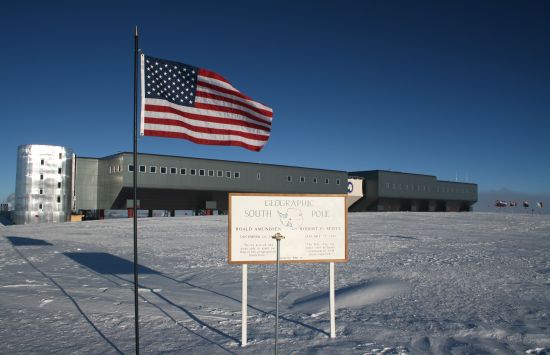
- Positioned at 90°S, the geographic South Pole.
- Sits atop the Antarctic ice sheet at an elevation of approximately 2,835 meters (9,301 feet) above sea level.
- Located in the interior of Antarctica, one of the most remote and extreme environments on Earth.
- Due to ice movement, the station drifts approximately 10 meters (33 feet) each year.
Biodiversity, natural environment and climate
- The station is surrounded by a polar desert, characterized by ice and snow. It is one of the harshest climates on Earth.
- Due to the extreme cold and isolation, there is very limited biodiversity. No native plant or animal life exists at the South Pole itself.
- Annual average temperature is around -49°C (-56°F), temperatures can drop below -80°C (-112°F) during winter.
- Precipitation is minimal, averaging about 2.5 cm (1 inch) per year, primarily as ice crystals.
History
- Opened in 1956 as part of Operation Deep Freeze to support scientific exploration during the International Geophysical Year (1957-1958).
- Named after Roald Amundsen, the first to reach the South Pole in December 1911, and Robert F. Scott, who arrived shortly after in January 1912.
- The original station, the “Old Pole,” was built by an 18-man U.S. Navy crew, the first group to winterover at the South Pole.
- In 1975, the central area of the station was rebuilt as a geodesic dome 50 meters wide and 16 meters high that covered modular buildings, fuel bladders, and equipment. Several science and berthing structures were added in the 1990s.

Facilities
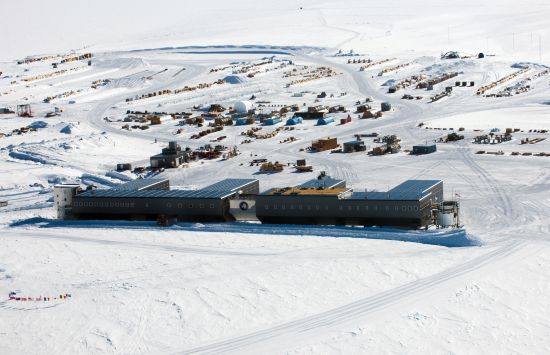
- The current elevated station was completed in 2008 to improve resistance to snow accumulation and harsh conditions.
- Infrastructure includes approximately 47 buildings of varying sizes, including housing, offices, science laboratories, a store, a food growth chamber and dining, recreation and medical services.
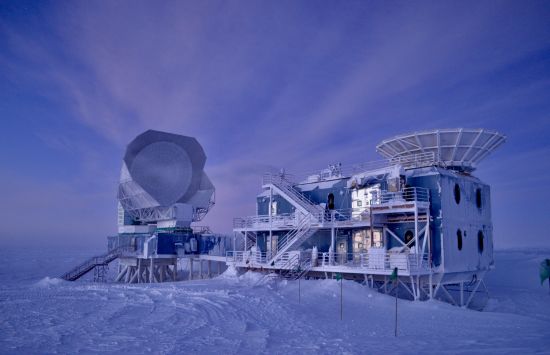
- South Pole hosts the Martin A. Pomerantz Observatory, Atmospheric Research Observatory, South Pole Telescope, seismic instruments and a massive in-ice neutrino detector, the IceCube South Pole Neutrino Observatory.
- Resupply operations during the austral summer (November to mid-February) bring up to 450,000 gallons of fuel, personnel and cargo.
- Most personnel travel from NSF McMurdo Station on ski-equipped aircraft, while cargo and fuel often arrive via surface traverse from McMurdo Station.
Population
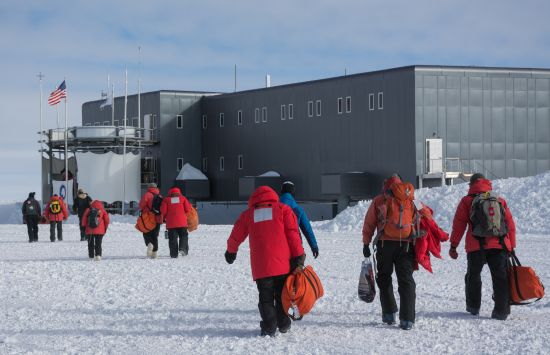
- Up to 150 people during a week in the summer season.
- Up to 42 people during a week in the winter season.
- 640 people move through the station annually.
- 24,354 meals are served a year.
Scientific research and activities
- The station supports scientific studies in astronomy, astrophysics, aeronomy, auroral studies, geospace research, meteorology, geomagnetism, seismology, earth-tide measurements and glaciology.
- The station's geographic location allows unique astronomical observations, benefiting from clear, dry air and the absence of light pollution.