Robotics engineer Daniela Rus sees a future in which robots not only do what
we want, they become what we want. Hear more in this audio story.
Credit: MIT
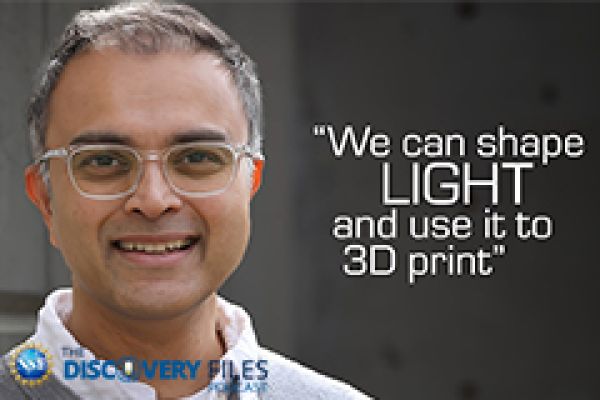
3-D printing is an innovative manufacturing technique developed by Michael Cima and Emanuel Sachs from the Massachusetts Institute of Technology. Once just used to create working prototypes, 3-D printers are now used by people from engineers to home inventors to make objects from their imaginations. Learn more in this Science of Innovation video.
Credit: NBC Learn, U.S. Patent and Trademark Office, and National Science Foundation
The Division of Computing and Communication Foundations (CCF) of the Directorate for Computer and Information Science and Engineering supports research and education projects that explore the foundations of computing and communication devices and their usage. The Division seeks advances in computing and communication theory, algorithms for computer and computational sciences, and architecture and design of computers and software.
They're soft, biocompatible, about 7 millimeters long--and, incredibly, able to walk by themselves. Miniature "bio-bots" developed at the University of Illinois are making tracks in synthetic biology. The walking bio-bots demonstrate the Illinois team's ability to forward-engineer functional machines using only hydrogel, heart cells and a 3-D printer.
March 18, 2013
Printable Robots Designed to Be Consumer-friendly, Inexpensive
Average person could design, customize and print a specialized robot in a matter of hours
This project, funded by the National Science Foundation's (NSF) Expeditions in Computing Program, envisions a future in which 3-D robotic systems can be produced and designed using 2-D desktop technology fabrication methods. If this feat is achieved, it would be possible for the average person to design, customize and print a specialized robot in a matter of hours. Currently, it takes years and many resources to produce, program and design a functioning robot. This project would completely automate the process, from sketches on-demand, anywhere, and with the skill of a team of professional engineers, leading to potential transformations in advanced manufacturing.
"This research aims to revolutionize the design and manufacture of robots, which could have a profound impact on society," says Ralph Wachter, a program director in the NSF Directorate for Computer and Information Science and Engineering. "It would remove barriers and allow the average person to create and customize his or her own robot to meet his or her specific needs. This opens the door to great possibilities in diverse fields spanning health care, energy and transportation."
"This research envisions a whole new way of thinking about the design and manufacturing of robots, and could have a profound impact on society," says MIT Professor Daniela Rus, project leader and director of the Computer Science and Artificial Intelligence Lab (CSAIL). "We believe that it has the potential to transform manufacturing and to democratize access to robots."
CSAIL is the largest interdepartmental laboratory at MIT and one of the world's most important centers of computer science and information technology research. The lab has played a major role in the technology revolution of the past 50 years. Currently, CSAIL is focused on conducting groundbreaking research in artificial intelligence, computer systems, and the theory of computation, while also tackling pressing societal challenges such as education, health care, manufacturing and transportation
"Our goal is to develop technology that enables anyone to manufacture their own customized robot. This is truly a game changer," adds engineering professor Vijay Kumar, who is leading the team from the University of Pennsylvania. "It could allow for the rapid design and manufacture of customized goods, and change the way we teach science and technology in high schools."
Any opinions, findings, conclusions or recommendations presented in this material are only those of the presenter grantee/researcher, author, or agency employee; and do not necessarily reflect the views of the National Science Foundation.