


NSF and DOE Announce Joint Funding Opportunity for Solar Energy Research
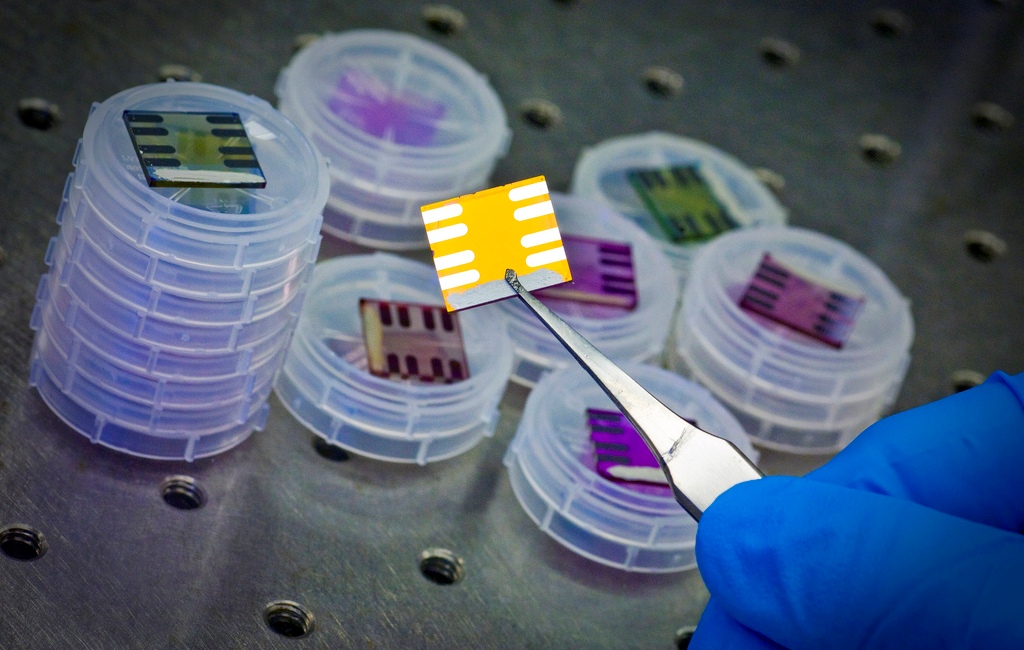
Solar cells could bring America significantly closer to a sustainable energy future.
April 18, 2011
The National Science Foundation (NSF) and the U.S. Department of Energy (DOE) will jointly provide up to $39 million for research to improve photovoltaic (PV) cell performance and reduce module cost for grid-scale commercial applications. The agencies released a joint Funding Opportunity Announcement (FOA) for the "Foundational Program to Advance Cell Efficiency" on April 8, 2011, to identify and fund solar device physics and PV technology research and development.
This collaborative effort is one of four programs in the SunShot Initiative recently announced by Energy Secretary Steven Chu. The SunShot Initiative aims to make solar energy technologies cost-competitive with other forms of energy by reducing the cost of solar energy systems by about 75 percent before 2020. Reducing the total installed cost for utility-scale solar electricity to roughly $1 per watt will result in rapid, large-scale adoption of solar electricity across the country. Reaching this goal will re-establish American technological leadership, improve the nation's energy security, and strengthen U.S. economic competitiveness in the global clean energy race.
SunShot's Foundational Program to Advance Cell Efficiency addresses the technical foundations of PV by taking advantage of the complementary roles of NSF and DOE. NSF's mission to support basic research and educate the next generation of engineers and scientists "feeds the pipeline" to DOE's applied research and later-stage development that matures technologies toward U.S. economic impact.
"NSF aims to create breakthroughs for sustainable energy through its investment in basic research," said Robert Trew, director of the NSF Division of Electronic, Communications, and Cyber Systems (ECCS). "We hope this collaboration with DOE will bring America significantly closer to a sustainable energy future."
-Cecile J. Gonzalez, NSF-
Media Contacts
Joshua Chamot, NSF, (703) 292-7730, jchamot@nsf.gov
Ebony Meeks, DOE, (202) 586-4940, Ebony.Meeks@hq.doe.gov
Program Contacts
George Maracas, NSF Division of Electrical, Communications, and Cyber Systems (ECCS) Program for Energy, Power, and Adaptive Systems (EPAS), (703) 292-8339, gmaracas@nsf.gov
Marie Mapes, DOE Office of Energy Efficiency and Renewable Energy (EERE) Solar Energy Technologies Program (SETP), (202) 586-3765, Marie.Mapes@ee.doe.gov
Web Resources
DOE SunShot: http://www.eere.energy.gov/solar/sunshot/
DOE News Release: http://www1.eere.energy.gov/solar/sunshot/news_detail.html?news_id=16874
The U.S. National Science Foundation propels the nation forward by advancing fundamental research in all fields of science and engineering. NSF supports research and people by providing facilities, instruments and funding to support their ingenuity and sustain the U.S. as a global leader in research and innovation. With a fiscal year 2023 budget of $9.5 billion, NSF funds reach all 50 states through grants to nearly 2,000 colleges, universities and institutions. Each year, NSF receives more than 40,000 competitive proposals and makes about 11,000 new awards. Those awards include support for cooperative research with industry, Arctic and Antarctic research and operations, and U.S. participation in international scientific efforts.

Connect with us online
NSF website: nsf.gov
NSF News: nsf.gov/news
For News Media: nsf.gov/news/newsroom
Statistics: nsf.gov/statistics/
Awards database: nsf.gov/awardsearch/
Follow us on social
Twitter: twitter.com/NSF
Facebook: facebook.com/US.NSF
Instagram: instagram.com/nsfgov