



NSF partners with NIST and Schmidt Sciences to support bioeconomy Scholars-in-Residence
The U.S. National Science Foundation and the U.S. National Institute of Standards and Technology (NIST), with substantial support from Schmidt Sciences, announced five Scholars-in-Residence awards to build expertise in and catalyze the development of standards and metrics for the bioeconomy.
The awards support the NSF and NIST missions to advance biotechnology and bioeconomy to ensure global competitiveness, national security, and economic growth of the U.S. NSF makes strategic investments in foundational and use-inspired research, technology translation, research infrastructure, and training. NIST promotes U.S. innovation and industrial competitiveness by advancing measurement science, standards and technology in many areas, including the bioeconomy. NIST convenes industry stakeholders to support the development and adoption of standards as a key component of technology translation and commercialization.
Schmidt Sciences accelerates scientific knowledge and breakthroughs with the most promising, advanced tools to support a thriving planet. The organization prioritizes research in areas poised for impact, including artificial intelligence and biosciences, among others, and also supports researchers across a variety of disciplines through its science systems program.
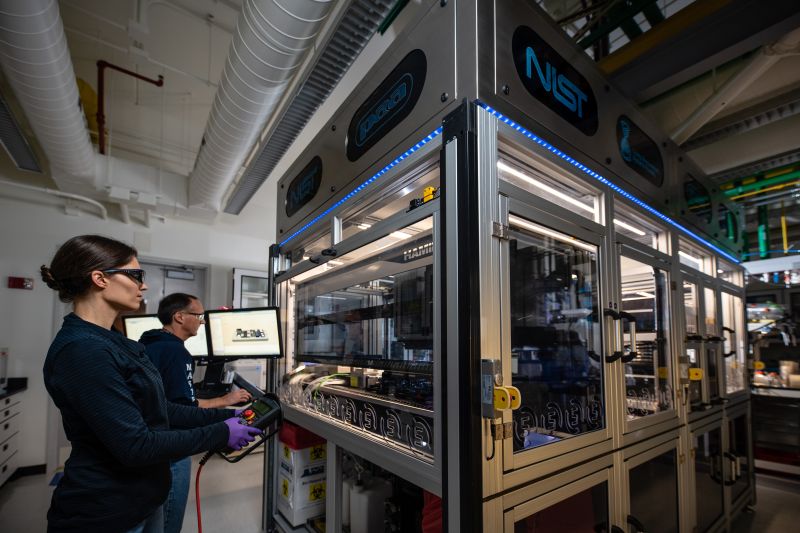
Through the Scholars-in-Residence awards, researchers will have the opportunity to spend dedicated time in a NIST laboratory learning first-hand to develop standards in fields associated with biotechnology and the bioeconomy. Scholars will play a pivotal role in enabling commerce through the development of standards and metrics focused on broadly applicable objectives and workflows commonly used for engineering microorganisms, cell lines, and cell-free systems. Key goals of the program are to accelerate engineering biology research and development and to enable curation of high-quality data for predicting gene function from sequence using artificial intelligence (AI). The initiative will make use of the state-of-the-art, integrated laboratory automation systems at NIST’s Living Measurement Systems Foundry, and the expertise of the full-time staff who will serve as hosts.
"NSF is delighted to be able to collaborate with NIST on the Bioeconomy Scholars-in-Residence program," said Theresa Good, NSF Biological Sciences Directorate head. "We look forward to the role that the first Scholars-in-Residence will have in creating the shareable standards that are so important for achieving the full potential of biofoundries and programmable cloud labs to advance the U.S. bioeconomy."
"NIST is pleased to welcome these scholars to our laboratories to collaborate directly on the metrics that will shape tomorrow's biotechnology," said Sheng Lin-Gibson, chief of the NIST Biosystems and Biomaterial Division. "Standards are the foundational enablers of both scientific predictability and commerce. Through this joint initiative with NSF, we will empower researchers to co-develop robust, AI-ready frameworks that accelerate engineering biology and foster greater trust in biotechnology R&D."
The awards are:
- Developing a Standardized AI-ready Pipeline for Organizing, Representing, and Training on Massive Datasets of Integrated Genetic Circuits.
The Boston University Scholar-in-Residence will deploy Knox, an AI-ready platform for standardized biological circuit design and analysis that integrates high-quality ribonucleic acid (RNA) circuit data with machine learning, to extract, formalize and experimentally validate design rules, accelerating the design-build-test-learn cycle and enabling broader community access to standards-aligned computational tools for biological circuits. - A Standard Enabled Synthetic Biology Workflow to Produce AI-Ready Data.
The University of Colorado Boulder Scholar-in-Residence will develop and implement a standard-enabled prototypical synthetic biology workflow, integrating open-source tools and protocols to produce AI-ready data and accelerating the design, testing and reliable modeling of synthetic biology across the community. - Biophysical Protein Ladders Standards for Benchmarking High-throughput Studies.
The University of Kansas Medical Center Scholar-in-Residence will generate protein ladders containing high-resolution samples of partial loss-of-function (pLoF) mutations to benchmark high-throughput assays for their ability to resolve pLoF mutations, helping AI tools more accurately predict protein function from sequence. - Defining Reproducibility in PURE Cell-Free Expression through Ontological Benchmarking and a Minimal Information Reporting Standard.
The University of Minnesota Twin Cities Scholar-in-Residence will leverage NIST's high-throughput capabilities to develop a minimal information standard for Protein synthesis Using Recombinant Elements (PURE) cell-free expression and provide benchmarking metrics enabling researchers to rigorously characterize, troubleshoot and compare PURE preparations at the molecular level. - Standardized Computational Workflows for Modeling and Inference of RNA Strand-exchange Circuits.
The Utah State University Scholar-in-Residence will develop a standardized, machine-readable computational workflow that combines experimental data with machine learning to improve the predictive power of mechanistic models of RNA strand-exchange circuits.
For more information: Dear Colleague Letter: NSF-NIST Scholars in Residence (NSF 25-041).