



NSF-funded researchers push driverless race cars to the limit to improve the performance and safety of autonomous vehicles
Watching drivers push race cars at top speeds has captivated the public for more than a century. The innovations developed by motorsports teams have also found their way into generations of everyday vehicles. Safety features such as rearview mirrors and seatbelts; performance improvements like disc brakes and tires with better traction; better aerodynamic designs; and lighter materials like carbon fiber can all be traced to efforts by motorsports competitors working to gain the slightest edge over their opponents.
This approach is now being applied to autonomous vehicles, as researchers funded by the U.S. National Science Foundation are part of a global effort to improve the integration of robotics and artificial intelligence through competition. Teams of university-based engineers and students are part of the Indy Autonomous Challenge (IAC), where they are accelerating the transition of theoretical research in areas such as autonomous vehicles, AI and cybersecurity into practical applications.
Refining automated vehicle technology at high speeds will contribute to safer performance by the growing number of driverless vehicles operating on public roadways.
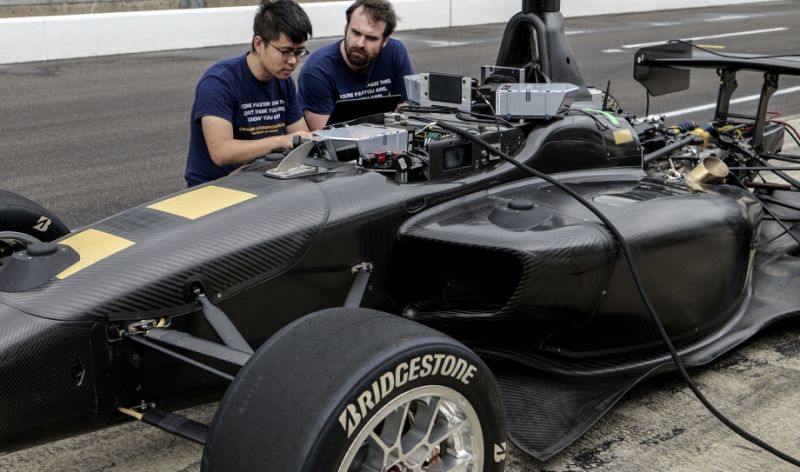
In 2024, the Cavalier Autonomous Racing team from the University of Virginia became the first American team to win an IAC event. Their vehicle reached 171 miles per hour in a time trial event to defeat nine other teams at Indianapolis Motor Speedway, which famously hosts the annual Indianapolis 500 race and was built in the early 1900s as a testing ground for the nascent automobile industry.
The test vehicles used by the IAC teams are the same ones used in the Indy NXT series, one step below the top level of IndyCar racing. The teams use identical chassis, engines and tires, but in the driver's cockpit is a computer that controls the vehicle using a suite of electronics, cameras and other sensors and runs on an open-source operating system.
The only difference among the racecars is the control software developed by each team. The winning team is the one that develops the best algorithms that safely navigate the car around the track the fastest. The high speeds of the competition push the software to react to any changes — other vehicles, unexpected obstacles, switching to other sensors in case of signal loss — in a way that would not be possible in normal road environments.
NSF support played a key role in the Virginia team's victory. The lead investigator received an NSF Faculty Early Career Development Program award for groundbreaking work in advancing the safety of autonomous cars and other autonomous vehicles such as drones. The research led to the development of the CRASH framework (Challenging Reinforcement-learning based Adversarial scenarios for Safety Hardening) — an innovative method to stress-test automated vehicle software under challenging and unpredictable traffic conditions.
While most IAC competitions have taken place at oval tracks, the researchers have advanced the technology enough to add new competitive wrinkles. The first head-to-head passing event took place in 2022, and the first road course event, which added additional turns and more braking and accelerating, took place in 2025.
A primary goal of the IAC is to advance technology that can speed the commercialization of fully autonomous vehicles and deployments of advanced driver-assistance systems. So, while competition is intense, all data is shared among the teams so that collective problem-solving can push the pace of discovery.
The roots of the IAC did not begin with full-sized vehicles. Researchers initially built small radio-controlled cars and shared their work with engineers around the globe via web videos. As other teams began building and experimenting with their own vehicles, competitions began to take place.
Both NSF and the IAC have embraced the scale-model platforms, which have helped lower the barrier for universities and high schools to participate in real-world autonomous vehicle experimentation. Through the scale models, thousands of students have learned about perception, planning, control and safety-critical AI under race-level performance constraints — the same technical foundations showcased in autonomous IndyCar demonstrations. The real-world experience gained has helped many students pursue careers in the autonomous vehicle and robotics sectors.