



Pioneers of quantum information science recognized with 2025 ACM A.M. Turing Award
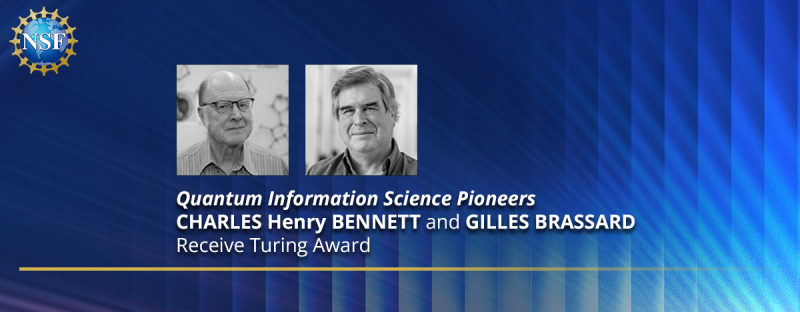
When Charles Bennett and Gilles Brassard began exploring how quantum mechanics might change the way information is stored, transmitted and protected, quantum information science did not yet exist as the broad research enterprise it is today.
Their ideas emerged from basic questions at the intersection of physics and computer science: What happens when information is treated not simply as an abstract mathematical object, but as something governed by the laws of nature? In answering that question, Bennett and Brassard helped open a new scientific frontier. Today, the Association for Computing Machinery recognized that achievement by awarding them the 2025 ACM A.M. Turing Award, one of the highest honors in computing.
For the U.S. National Science Foundation, the recognition highlights the long-term impact of fundamental research. More than half of Turing Award recipients have received NSF support at some point in their careers, often during the early stages of work that later transformed computing and information technology. Bennett's research on quantum information science, for example, was supported by NSF to advance the theory of reliable quantum communication and computation.
Bennett and Brassard are credited for showing that quantum phenomena could do more than describe the physical world. Those same phenomena could be used as resources for communication and computation. In 1984, they introduced what became known as the BB84 protocol, an early and foundational method for quantum key distribution. The protocol demonstrated that two parties could establish a shared secret encryption key using quantum particles of light. Because measuring an unknown quantum state inevitably disturbs it, any attempt at eavesdropping leaves detectable traces. The result was a new approach to secure communication grounded in the laws of physics, rather than in assumptions about the difficulty of solving mathematical problems, which has been a standard method to achieve secure communications.
Their work extended beyond cryptography. In 1993, Bennett and collaborators introduced quantum teleportation, demonstrating how the quantum state of a particle could be transferred from one location to another using entanglement and classical communication. The idea showed that entanglement — once considered mainly a philosophical curiosity — could function as a practical resource for transmitting information. A few years later, Bennett, Brassard and colleagues developed methods for entanglement distillation, showing how imperfect entangled states could be transformed into higher-quality ones suitable for reliable communication. These discoveries helped define the conceptual framework for quantum communication and quantum networking.
Today, quantum information science supports a rapidly growing global research community. The concepts pioneered by Bennett and Brassard helped catalyze new connections between physics and computer science, influencing areas such as algorithms, cryptography, computational complexity and information theory. Their work also helped inspire generations of researchers who now contribute to quantum computing, networking, sensing and other emerging technologies.
The trajectory of quantum information science illustrates how foundational research can lead to transformative advances. Since Bennett and Brassard first proposed their ideas, quantum communication and quantum computing have moved from theoretical concepts to experimental demonstrations, and researchers continue to explore new ways quantum systems can process information.
For the public, these developments may eventually lead to more secure communication, new tools for scientific discovery and technologies that support economic growth. Quantum computers could enable simulations of complex materials or chemical processes, while quantum networks could offer new ways to protect sensitive data and build larger quantum computers.
The recognition of Bennett and Brassard with the Turing Award reflects the lasting influence of their foundational contributions. It also underscores the importance of sustained support for fundamental science.
By investing in curiosity-driven research and the people who pursue it, NSF helps create the scientific foundations that enable discoveries, strengthen national prosperity and expand opportunities for future generations.