




Nature-inspired design yields new class of metamaterials
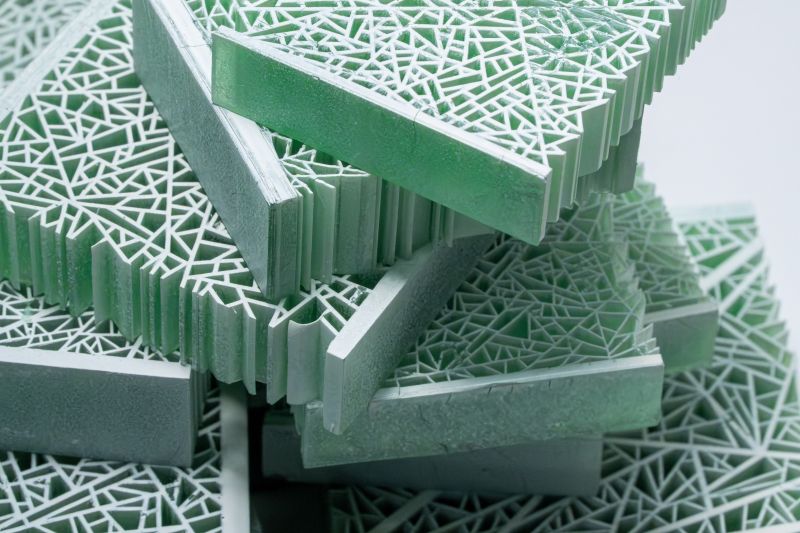
Researchers find that introducing controlled disorder into engineered materials can improve their ability to withstand impacts
Researchers supported by the U.S. National Science Foundation have developed a new approach to designing metamaterials that are stronger, more resilient, and better at absorbing impacts. This research could improve protective equipment such as helmets, packaging, and armor, as well as advanced materials for controlling sound and vibrations.
The team at the Massachusetts Institute of Technology and Northeastern University drew inspiration from complex networks found in nature, including leaf veins and dragonfly wings. Supported in part by the NSF Designing Materials to Revolutionize and Engineer our Future program and the NSF Graduate Research Fellowship Program, the researchers developed a new way of designing metamaterials that can better withstand mechanical stress. The findings were published in the journal Nature.
Metamaterials are engineered material systems whose physical properties are based on both their structural features and material characteristics. Typical metamaterials are designed around a building block. Stacked together, the building blocks form repeating patterns, like honeycombs or square lattices. The resulting structures can be exceptionally strong but come with limitations: when one section breaks or buckles, neighboring sections can easily fail.
To minimize the risk of structural failure, researchers introduced variations into the metamaterials' internal structures. Rather than using repeating identical building blocks, they developed a new class of materials called "scale-rich" metamaterials. These structures resembled the irregular, web-like networks found in biological systems, where connections of varying sizes reduce the risk of structural failure.
To do this, the researchers first developed a computer algorithm to generate networks of interconnected beams. Using the algorithm, supported by experimental data, the researchers established a new framework for designing mechanical metamaterials with desired properties. The resulting networks are described as "scale-rich," meaning they contain beams with varying lengths, thicknesses, and connectivities within a single system.
The research team then 3D-printed samples to test their performance against conventional metamaterials. The results showed that the web-like, interconnected structures withstood impact better than conventional designs.

Scale-rich metamaterials (at right) exhibit evenly distributed—or delocalized—deformation compared to classical periodic metamaterials such as the square lattice (at left).
Andrew Chen
To demonstrate how scale-rich materials could protect fragile objects, researchers created a structure inspired by the thick rind of a pomelo fruit. The metamaterial featured a denser network of internal beams that successfully cushioned and protected the fragile object at its center.
"With the help of network sciences, this foundational research illuminates how forces and deformation travel through material networks at various length scales," says Siddiq Qidwai, Program Director at the NSF Directorate for Engineering. "This approach could enable faster discovery and deployment of bespoke metamaterials for health, security, and other applications."
The findings offer a new model for engineering metamaterials with properties tailored for specific applications, from protective equipment to advanced mechanical systems.
This article was originally published by the Massachusetts Institute of Technology. It has been edited for length and style.
Read the full story: Inspired by networks found in nature, engineers design stronger, more resilient "metamaterials"