





Artificial intelligence is accelerating discovery, economic competitiveness and the future workforce, making access to advanced AI research and education resources essential to U.S. leadership in innovation.
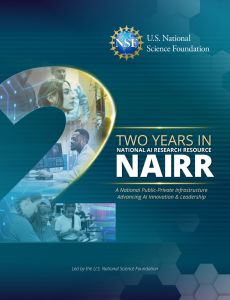
The U.S. National Science Foundation-led National Artificial Intelligence Research Resource (NAIRR) is a scalable national infrastructure that provides the research and education communities with access to the critical computing, software, data, models, educational resources and expertise needed to advance AI innovation for the U.S.
The key goals of NAIRR are:
- Accelerate AI and AI-powered discovery and innovation.
- Expand the AI workforce and train the next generation of AI researchers and educators.
- Increase capacity, integration and use of world-class public and private-sector AI resources.
- Advance AI interpretability, security and trust.
 On this page
About NAIRR
Initially established as a pilot in 2024, the NAIRR concept has become a proven national research infrastructure, supporting more than 600 research projects and 6,000 students across all 50 states, Washington, D.C. and Puerto Rico. By partnering with 13 other federal agencies and 28 nongovernmental partners, NAIRR bridges a gap that neither the private sector nor government can address alone: making available the tools to enable early, high-risk, high-reward research activities and building foundational AI capabilities long before they are commercially viable.
The pilot phase of NAIRR validated the importance of a coordinated national AI infrastructure and was recognized in the White House Science and Technology Highlights: Year One report. Building on this success, and consistent with the White House AI Action Plan, NSF has released an opportunity to establish the NAIRR Operations Center to transition NAIRR from a pilot to a sustained national capability.
The next phase of NAIRR will establish a lean, long-term operational structure that, through continued partnerships with leading technology companies, expands access to world-class resources and creates practical pathways for researchers, startups and small businesses to participate in a competitive, open and innovative AI ecosystem, directly advancing the AI Action Plan's directive to foster open, innovative and competitive AI development.
Operational focus areas
NAIRR for Research
Led by NSF, this focus area advances U.S. AI leadership and AI-enabled scientific discovery by expanding access to advanced AI research resources through the NAIRR portal and coordinated allocations, including deep collaboration opportunities with private sector partners.
NAIRR Secure
Led by the National Institutes of Health and the U.S. Department of Energy, this focus area strengthens secure, privacy-preserving AI research by exploring the use of privacy/security-preserving infrastructure and the benefits of secure environments for research areas using high-quality AI-ready controlled-access data.
NAIRR Data and Models
Led by NSF, this focus area promotes interoperability, reproducibility and efficient integration of AI software, platforms, tools, datasets and services, supporting scalable AI research across the NAIRR ecosystem.
NAIRR Classroom
Led by NSF, this focus area develops an AI-ready workforce by expanding education, training, user support and outreach to new and nontraditional research and learning communities across the U.S.
+DC +Puerto Rico
How to get involved
Access resources:
Visit nairrpilot.org to explore opportunities for researchers, educators and students, including access to computational resources, cloud computing environments, AI-ready datasets, pre-trained models and more.
Participate in events and workshops:
The NAIRR community of partners holds regular events and technical workshops to engage the community in an iterative design process. Visit nairrpilot.org to learn about upcoming events and subscribe to the community-run NAIRR newsletter.
NAIRR partners and contributors
Led by NSF, NAIRR brings together a coalition of federal agencies and nongovernmental contributors to make a wide range of resources available and accessible to the U.S. research community.
Federal agency partners
In addition to NSF, the following U.S. federal agencies are participating and contributing computational and data resources to NAIRR:
Contribution: DARPA will make a set of open-source tools and environments available to the NAIRR pilot user community, including those that support assurance of autonomous systems, development of machine common sense capabilities, and robustness against adversarial attacks.
Contribution: NASA will provide datasets to support AI model development, contribute expertise in the development of foundational models, and offer hands-on tutorials to assist the research community in fine-tuning and using these models.
Contribution: NIST will provide expertise on best practices for AI governance, risk management, and testing and evaluation for responsible AI to aid in the management of the NAIRR pilot.
Contribution: NIH will co-lead the NAIRR Secure pilot effort with DOE and provide open and controlled-access to NIH computing and data platforms and biomedical datasets to support healthcare-focused AI research.
Contribution: Leveraging the NOAA Open Data Dissemination program, NOAA will make datasets of interest available to the NAIRR user community.
Contribution: USDA will make the forthcoming 2022 Census of Agriculture dataset available and accessible to the research community through the NAIRR pilot infrastructure.
Contribution: ED will furnish education research and statistics datasets, while also providing expertise in the development and project management of foundational models. This support aims to aid the NAIRR pilot user community in accessing AI model development resources.
Contribution: DOE will provide allocations on the Summit pre-exascale supercomputer as well as access to AI testbeds, training resources and associated expertise, and will lead the NAIRR Secure pilot effort together with the National Institutes of Health.
Contribution: VA will support the NAIRR pilot through its National AI Institute and AI Network including providing expertise (i.e., training and governance), best practices supporting trustworthy AI, lessons from AI pilots, as well as experience in supporting AI for health use cases. VA will collaborate on NAIRR Secure to explore health-related efforts most important to jointly serving the needs of veterans and Americans.
Contribution: DoD will contribute expertise to the management and allocation of NAIRR pilot computing resources as well as a responsible AI toolkit to assist NAIRR users in crafting responsible approaches to AI research.
Contribution: FDA, via the Office of Science and Engineering Laboratories (OSEL) in the Center for Devices and Radiological Health (CDRH), will make AI-specific test methods, datasets and evaluation methodologies available to the NAIRR community. These tools, developed by OSEL's AI program, are intended to aid researchers and innovators with safety, effectiveness and performance assessment, in both premarket and real-world settings, of novel AI solutions.
Contribution: USGS is making datasets supporting AI model development available to the NAIRR pilot user community.
Contribution: USPTO will provide access to rich datasets for AI training and will support public challenges to spur the development of novel data products.
Nongovernmental partners
The following private sector, nonprofit and philanthropic partners committed to the NAIRR during its pilot phase:
Contribution: Access to a fully open ecosystem of data, models, training and evaluation software necessary to support a scientific approach to AI research. Initial access will be provided to AI2 Dolma, the largest open dataset to support language model pre-training.
Contribution: Support for at least 20 research projects through access to AWS credits for storage, compute and AI services to build, train and deploy machine learning (ML) models. AWS will also work with the NAIRR pilot to publicize AWS resources to accelerate AI research, including access to pre-trained and customizable AI/ML models, AI/ML training resources and 500+ datasets through the Registry of Open Data on AWS.
Contribution: Application support for NAIRR pilot users running applications on AMD hardware and collaboration with cloud vendor sites offering access to AMD hardware.
Contribution: API access to Anthropic's Claude model for 10 researchers working on climate change-related projects. Anthropic will also provide educational resources to help those researchers experiment with prompt engineering.
Contribution: Access to Cerebras systems and clusters, providing up to four EXAFLOPs of AI compute for NAIRR pilot projects and users and enabling them to rapidly train AI models. Cerebras will also contribute access to open-source datasets and models, and time from its expert data scientists and AI researchers to facilitate project selection, definition and success.
Contribution: Access to Databricks' Data Intelligence Platform for NAIRR pilot users. This will facilitate use of Databricks' data processing tools by the research community to analyze existing datasets and create entirely new ones.
Contribution: $2.6 million in the form of access to Datavant's privacy-preserving record linkage platform, privacy-preserving data discovery tools, and staff expertise in support of the NAIRR Secure NIH component of the pilot as well as elements of the future NAIRR software stack.
Contribution: 100,000 hours of GPU access to support an effort in the research community to train a foundation model for scientific research, in addition to support and expertise for using EleutherAI's large language model training library on high-performance computing systems.
Contribution: Collaboration across Google Colab, Kaggle and Data Commons programs, including licenses for Colab's virtual notebooks, integration of Kaggle public resources onto NAIRR pilot infrastructure, and partnership on competitions and red teaming of models. In addition, Data Commons will co-locate an instance of Data Commons with NAIRR pilot computing infrastructure to facilitate the ability of the research community to use its diverse, integrated datasets.
Groq is providing access for up to 10 research teams to use Groq's Language Processing Unit (LPU) Inference Engine via GroqCloud.
Proposed contribution: Time on GPU-powered supercomputing platforms and discounts on supercomputing resources for potential expansion of the NAIRR pilot. In addition, HPE will provide licenses to HPE Machine Learning Development Environment and HPE Machine Learning Data Management Software along with hands-on training for researchers who will have access to datasets, digital twins and performance and productivity tools.
Contribution: 100 compute grants for NAIRR pilot projects and participants to support access to Hugging Face Spaces demos of systems and model evaluation, inference and fine-tuning. Hugging Face will also partner with the NAIRR pilot to set up sharing and evaluation leaderboards for datasets and models developed through or hosted by the pilot.
Contribution: Datasets and benchmarks focused on AI safety and trust evaluation as well as geospatial, time series, materials and chemistry foundation models. IBM will also provide expertise and assistance to researchers working with these resources.
Contribution: Technical training on Intel server platforms, AI technologies and software optimization for NAIRR pilot users working with Intel hardware.
Contribution: Access to Lexset's Seahaven synthetic data creation software and tools. Lexset will also provide staff time and expertise to support research community data creation projects.
Contribution: Collaboration with NAIRR pilot researchers to support research on Meta's Llama suite of models, consistent with applicable model licenses.
Contribution: $20 million in compute credits on Microsoft Azure, along with access to leading-edge models, including those available via Azure OpenAI Service. Availability of state-of-the-art resources for developing trustworthy and responsible AI applications, including tools for research and development (R&D) on AI fairness, accuracy, reliability, transparency, privacy and security, and model orchestration. Offerings include resources to enable HIPAA-compliant computing in support of health care research, access to innovative tools for scientific discovery through Azure Quantum Elements, and opportunities to forge collaborative relationships with Microsoft's scientists and engineers.
Contribution: Access to the MLCommons technology platform to enable testing of AI systems as well as access to AI benchmarks and the suite of MLPerf training, inference and storage benchmarks. MLCommons will also provide hosting services for select open datasets developed by the NAIRR pilot user community.
Contribution: $30 million in overall support for the pilot, including $24 million worth of computing on NVIDIA's DGX Cloud platform integrated with NVIDIA AI software tools and supported by technical subject-matter experts to assist NAIRR pilot users. In addition, NVIDIA will provide AI software platform licenses to national supercomputing centers integrated with the NAIRR pilot, and run deep-learning workshops, AI boot camps and AI hackathons for NAIRR pilot users.
Contribution: $500,000 in support of the pilot effort, which includes computing infrastructure, dedicated staff time and expertise from portfolio partners. Additionally, Omidyar Network will co-sponsor workshops and future calls for proposals, fostering an inclusive environment for innovation and knowledge-sharing.
Contribution: Up to $1 million in credits for model access for research related to AI safety, evaluations and societal impacts, and up to $250,000 in model access and/or ChatGPT accounts to support applied research and coursework at historically Black colleges and universities and minority-serving institutions. Additionally, OpenAI will provide next-generation AI technology and data processing tools to aid in the digitization and structuring of large-scale datasets that are not currently available for research.
Contribution: Access to an integrated architecture based on privacy-enhancing technologies and up to $500,000 in cloud credits to support research partnerships working to develop AI solutions with sensitive or distributed data.
Contribution: Supports the NAIRR Secure pilot and the expansion of the National Clinical Cohort Collaborative through access to Palantir’s Foundry and AIP platforms deployed at the National Institutes of Health, including compute hours and platform support resources.
Contribution: Large-scale clinical datasets derived from real-world health care data in support of the NAIRR Secure pilot to bolster AI research and innovation in health care.
Contribution: Hosted environment for NAIRR pilot researchers to access pre-configured generative AI and large language models for domain specific fine-tuning and experimentation. Researchers will receive training and technical support to ensure project success. Technical assistance will also be provided for researchers utilizing the SambaNova cluster deployed at Argonne National Laboratory.
Contribution: $2.4 million in the form of access to Vocareum notebooks and cloud resources for 20,000 students, enabling educators to deliver hands-on AI education in their classrooms.
Contribution: One million GPU-hour compute credits, localized storage and associated staff time and expertise to support projects for the research community.
Contribution: Free academic licenses for NAIRR pilot users to access Weights & Biases' AI Developer Platform, and technical support to maximize impact from use of the platform.
In addition, the recently formed AI Alliance will work with NAIRR as a collaborating consortium, making the open-source tools and models developed by the AI Alliance accessible to the broader AI research community through the NAIRR platform.

About the NAIRR Task Force
The "National Artificial Intelligence Initiative Act of 2020" called on NSF, in coordination with the White House Office of Science and Technology Policy (OSTP), to form a National AI Research Resource Task Force to investigate the feasibility of establishing a NAIRR and develop a roadmap detailing how such a resource could be established and sustained.
Launched in June 2021, the NAIRR Task Force culminated its work in April 2023, dissolving 90 days after the submission of its final report, per its legislative mandate.
In its final report, the NAIRR Task Force laid out a phased approach for implementing NAIRR, including its administration, policies, security framework and cyberinfrastructure.
Task force members
Congress directed that the director of OSTP and the director of NSF, or their designees, serve as the co-chairpersons of the NAIRR Task Force. It also mandated that the task force be composed of 12 technical experts: four from government, four from institutions of higher education and four from private organizations.
The following experts served on the NAIRR Task Force. Titles listed reflect those held at the time of service on the task force:
- Tess DeBlanc-Knowles (co-chair, beginning Aug. 2022), Senior Policy Advisor, National AI Initiative Office, White House Office of Science and Technology Policy.
- Manish Parashar (co-chair, beginning Oct. 2021), Office Director of the Office of Advanced Cyberinfrastructure, U.S. National Science Foundation.
- Lynne Parker (co-chair, June 2021 – August 2022), was Founding Director of the National AI Initiative Office, White House Office of Science and Technology Policy.
- Erwin Gianchandani (co-chair, June 2021 – October 2021), Senior Advisor for Translation, Innovation and Partnerships, U.S. National Science Foundation.
- Daniela Braga, Founder and CEO of DefinedCrowd.
- Mark E. Dean, Ph.D.
- Oren Etzioni, CEO, Allen Institute for AI.
- Julia Lane, Professor, New York University; CEO, the Coleridge Initiative.
- Fei-Fei Li, Sequoia Professor of Computer Science at Stanford University and Denning Co-Director of the Stanford Institute for Human-Centered AI (HAI).
- Andrew Moore, Vice President and General Manager, Google Cloud AI and Industry Solutions.
- Michael L. Norman, Distinguished Professor, University of California, San Diego.
- Dan Stanzione, Executive Director, Texas Advanced Computing Center/Associate Vice President for Research, The University of Texas at Austin.
- Frederick H. Streitz, Chief Computational Scientist, Lawrence Livermore National Laboratory.
- Elham Tabassi, Chief of Staff, Information Technology Laboratory, National Institute of Standards and Technology.
Task force meeting materials
Materials from the task force's public meetings are available below.
Meeting #1: July 28, 2021, from 1:00–5:00 p.m. EDT. For more information, refer to Federal Register Notice 86 FR 33380.
Meeting #2: August 30, 2021, from 11:00 a.m. – 5:00 p.m. EDT. For more information, refer to Federal Register Notice 86 FR 41997.
Meeting #3: October 25, 2021, from 11:00 a.m. – 5:00 p.m. EDT. For more information, refer to Federal Register Notice 86 FR 43684.
Meeting #4: December 13, 2021, from 11:00 a.m. – 6:00 p.m. EST. For more information, refer to Federal Register Notice 86 FR 43684.
Meeting #5: February 16, 2022, from 11:00 a.m. – 5:00 p.m. EDT. For more information, refer to Federal Register Notice 86 FR 67500.
Meeting #6: April 8, 2022, from 11:00 a.m. – 5:00 p.m. EDT. For more information, refer to Federal Register Notice 87 FR 11100.
Meeting #7: May 20, 2022, from 2:00–3:00 p.m. EDT. For more information, refer to Federal Register Notice 87 FR 16034.
Meeting #8: July 25, 2022, from 11:00 a.m. – 5:00 p.m. EDT. For more information, refer to Federal Register Notice 87 FR 36153.
Meeting #9: September 12, 2022, from 11:00 a.m. – 5:00 p.m. EDT. For more information, refer to Federal Register Notice 87 FR 49615.
Meeting #10: October 21, 2022, from 1:00 p.m. – 3:00 pm. EDT. For more information, refer to Federal Register Notice 87 FR 57927.
Meeting #11: January 13, 2023 from 1:00–2:00 p.m. EST. For more information, refer to Federal Register Notice 87 FR 77641
Additional resources
- NAIRR web portal
- Fiscal Year 2027 Administration Research and Development Budget
- NSF Artificial Intelligence
- Winning the Race: America's AI Action Plan
- AI Institutes Virtual Organization
- National AI Research Resource Task Force Charter
- NAIRR Task Force interim report to the President and Congress (2022)
- NAIRR Task Force Request for Information (2022)
- NAIRR Task Force Request for Information (2021)