




Transforming and safeguarding the fabric of the nation
The NSF Textile Innovation Engine of North Carolina, led by The Industrial Commons, is advancing breakthrough technology and skills-based training to revitalize textile research, development and production in the U.S. Southeast.
Building on the region's deep textile heritage, the NSF Textile Innovation Engine brings together growers, manufacturers, major U.S. brands and partners across research, education and government.
This growing ecosystem is leveraging advances in artificial intelligence, circular textile technology and shifting market demand to develop solutions that de-risk textile investments and translate research into measurable economic impact.
Technologies of focus include:
- Advanced textile materials for high-tech and extreme environment applications, including first responders, healthcare and national defense.
- Processes for circular and natural materials development to extend textile life cycles.
- Biobased materials discovery to strengthen domestic supply chains and reduce harmful byproducts.
- Technologies for supply chain traceability and materials demand-supply match, increasing industry resiliency and market responsiveness.
- Advanced manufacturing, fiber identification and automation technologies that boost productivity and domestic competitiveness.
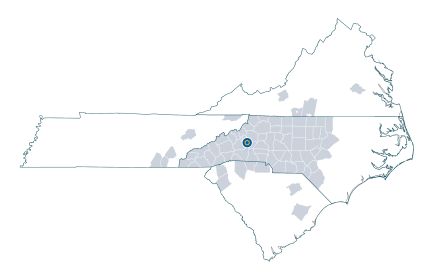 Region of service
The Textile Innovation Engine is centered in North Carolina's historic "textile belt" and extends into counties in South Carolina, Tennessee and Virginia. The region is home to the largest concentration of textile workers in the United States, with over 27,000 individuals employed in the industry and an additional 30,000 working in adjacent industries, such as biomedical devices, automotive and aerospace materials and furniture manufacturing. This dense and interdependent industrial base positions the region to accelerate research translation, workforce development and domestic textile manufacturing.
Addressing challenges in a key U.S. sector
Textiles are foundational to daily life, from apparel to the operating room and from aerospace to military applications, textiles provide comfort, protection and critical infrastructure. Yet most textile manufacturing happens overseas, increasing U.S. reliance on foreign nations for critical materials. At the same time, textile waste continues to accumulate in landfills nationwide, contributing to soil and water contamination.
The Textile Innovation Engine is shifting this trajectory. Through coordinated collaboration with researchers, supply chain, market, education and government leaders, this engine is accelerating new material discovery, scaling technologies and providing workforce solutions that strengthen U.S. textile production and material circularity — while ensuring the resulting economic impact and job creation remains rooted locally.
Workforce development: Building North Carolina’s advanced textiles talent pipeline
Through collaborations between academic institutions, community organizations and textile manufacturers, the Textile Innovation Engine is leading workforce development initiatives designed to align talent pipelines with industry needs.
These efforts include:
- Development of a new advanced textiles curriculum for North Carolina high school students, launched in fall 2025 in schools statewide in partnership with the North Carolina Department of Public Instruction.
- Creation and launch of the North Carolina Textile Career Map, a digital tool connecting high-wage textile careers to skill requirements and available training.
- Development of new augmented reality/virtual reality training for advanced textile manufacturing, capable of reducing technical training time for high-demand textile roles by up to 75%.
Together, these initiatives expand access to high-quality jobs and support durable economic growth.
Examples of recent impacts
- The Textile Innovation Engine catalyzed over $70 million in private capital, philanthropic funding and research and development investments for advanced textile systems and solutions.
- Nearly 3,000 individuals were trained or hired in complex and technical skills positions for advanced textile manufacturing.
- Six new patents and 28 R&D projects moved forward with support from the Textile Innovation Engine.
- 2,500 North Carolina high school students completed a new, statewide advanced textiles curriculum, which is projected to reach 25,000 students by the end of 2030.
Additional information
Lead Organization: The Industrial Commons
NSF awards: NSF-2315305
Key technology areas:
Advanced Manufacturing, Artificial Intelligence, Materials Research