




Turning waste into wealth and health for the Great Lakes region
The NSF Great Lakes RENEW (Recovery of Energy, Nutrients, critical Elements and Water) Engine, led by Current, is advancing technologies that remove harmful contaminants from water; recover critical minerals, energy and nutrients; and improve water efficiency for water-intensive industries across the Great Lakes region.
Drawing on the region's water assets, the NSF Great Lakes RENEW Engine has brought together more than 75 partners across six states — including research universities, national laboratories, water utilities, industry leaders and community organizations — to develop solutions that strengthen freshwater systems and accelerate economic growth.
Technologies of focus include:
- Advanced filtration and separation technologies that remove PFAS, heavy metals and other harmful contaminants from municipal and industrial water systems, allowing for water reuse for industrial and commercial applications.
- Resource recovery methods that extract critical minerals, nutrients and energy from waste and wastewater, supporting circular manufacturing and domestic supply chains.
- Advanced sensing and water quality monitoring tools that detect contamination in real-time and support rapid response to potential threats.
- Process technologies for water-intensive industries that improve how water is managed, treated and recycled, lowering costs and reducing waste.
- Data-driven water management technologies that optimize treatment processes, infrastructure performance and resource utilization.
- Artificial Intelligence/machine learning-enabled science and materials discovery to accelerate innovation and support a circular water economy.
 Region of service
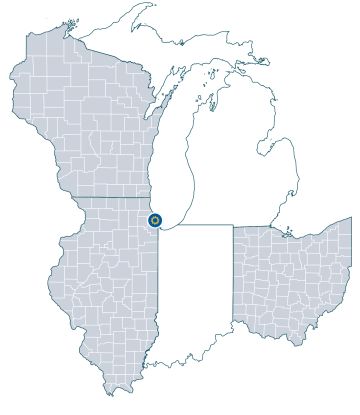
The Great Lakes RENEW Engine serves the Great Lakes basin, including Illinois, Indiana, Michigan, Minnesota, Ohio and Wisconsin. This region holds about 90% of the nation's surface freshwater and approximately 20% of the world's surface freshwater. It is also home to water-intensive industries such as advanced manufacturing, energy production and data infrastructure, as well as some of the nation's largest water and wastewater treatment facilities. This makes the region a valuable testing ground for emerging water technologies.
Addressing challenges in a key U.S. sector
Water systems across the U.S. are facing growing pressure brought by industrial demand, aging infrastructure, emerging contaminants and weather-related disruptions. Large data centers can consume up to 5 million gallons of water per day, equivalent to the daily water use of a town of up to 50,000 people. Left unaddressed, these pressures threaten economic competitiveness and community water supplies. At the same time, wastewater streams contain untapped resources, including nutrients, energy and critical minerals, that are often lost during treatment.
The Great Lakes RENEW Engine is turning this challenge into an opportunity by advancing technologies that recover valuable resources from water, enable water reuse and improve water system performance and reliability.
Workforce development: Building the Great Lakes water technology talent pipeline
The Great Lakes RENEW Engine is expanding career pathways and educational opportunities to build a talent pipeline for the new water-focused jobs emerging from the Great Lakes ecosystem.
These efforts include:
- Completing a comprehensive labor market analysis focused on the major metros in the Great Lakes region, identifying 1.3 million blue economy jobs and 121,000 annual openings.
- Launching programs with workforce partners like HIRE360 and OAI to expand and upskill the workforce needed to modernize infrastructure, treat contaminants, monitor systems and recover valuable resources from water.
- Expanding K-12 STEM programming to engage studentsacross the Great Lakes region in water technology-focused learning.
Supporting internships, hands-on learning opportunities and pilot projects that connect students with real-world water technology challenges.
Examples of recent impacts
- Raised or leveraged $16.4 million in investments in water-focused technology.
- Expanded a partner-driven connected testbed network to accelerate technology commercialization, with more than 400 emerging water technologies tracked and 40 pilot projects launched through the network.
- Trained more than 550 workers for the blue economy and engaged more than 1,400 K-12 students in water-focused science, technology, engineering and mathematics learning activities.
- Funded 12 cutting-edge research and development projects to advance technologies that recover valuable materials, remove contaminants, enable water reuse and advance testbed development.
- 5 new patent filings from the NSF Great Lakes RENEW Engine ecosystem.
- Provided tailored commercialization support to 22 water technology startups through three new entrepreneurship programs: the Sustainable Water Technology Accelerator with mHUB, the Great Lakes RENEW I-Corps Water Innovation Program and the Mining Water Technology Pilot Pathways Program with Nomadic Venture Partners.
Additional Information
Lead organization: Current Innovation NFP
Region of service: Great Lakes region (Illinois, Indiana, Michigan, Minnesota, Ohio, Wisconsin)
NSF awards: NSF-2315268
Key technology areas
Artificial Intelligence, Biotechnology, Semiconductors and Microelectronics