




Clumps and knots of gas found in remains of supernova explosion
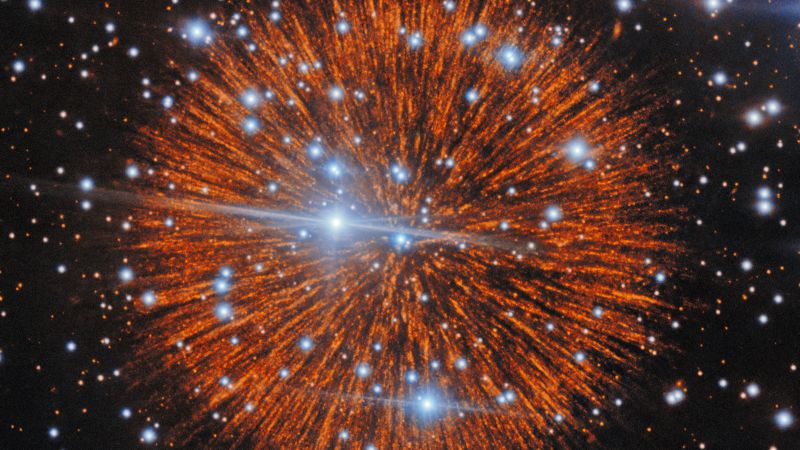
New, highly detailed observations of a nebula formed by a supernova over 800 years ago reveal a complex structure not seen before by astronomers
Researchers using a scientific facility supported by the U.S. National Science Foundation have found new details in the remnants of a supernova observed from Earth over 800 years ago. The new observations are of a nebula in the Milky Way galaxy thought to be the exploded remains of a supernova seen in the year 1181 and documented in historical records. Analysis of the new and highly detailed observations revealed that the nebula's firework-like gas filaments are not the smooth streaks of gas they initially appeared to be — rather, they are clumpy and knotted.
The nebula, named Pa 30, resides in the constellation Cassiopeia, which is visible in the northern sky. Researchers made new observations using the Gemini North telescope in Hawaii, one half of the International Gemini Observatory. The observatory is an international collaboration led by NSF in partnership with Canada, Chile, Brazil, Argentina, and the Republic of Korea. The data and analysis were published this month in The Astrophysical Journal.
The observations showed complex filamentary structure never before seen in a supernova's remains. Although the cause is unknown, the analysis suggests that substantial variations in temperature or density of the gas, dust, and charged particles surrounding the star when it exploded could have shaped the ejected stellar material into clumps and knots as it expanded outward.
Amateur astronomer Dana Patchick discovered Pa 30 in 2013. Later observations at NSF Kitt Peak National Observatory revealed its distinctive radial filaments. Based on its estimated age and brightness, scientists believe that Pa 30 is a remnant of a supernova observed from Earth in 1181 and documented by Chinese, Japanese, and Arabic astronomers.
Pa 30 is unique among all known supernova remains. At the center of its sphere of gas filaments is a star that was born from the extreme heat and compression of a supernova explosion caused by two merging stars. That central star that emerged is extremely hot, with a temperature of about 200,000 degrees Celsius (around 360,000 degrees Fahrenheit). The surrounding atmosphere of Pa 30's star also has very fast charged particles zooming around it, known as stellar winds. They move at about 36 million miles per hour.
This article was originally published by NSF NOIRLab. It has been edited for length and style.
Read the full story: Gemini North Reveals Pearl-Like Knots in the Remnant of a Supernova Witnessed in the Year 1181