



NSF fires up full-power operations at America's most powerful laser
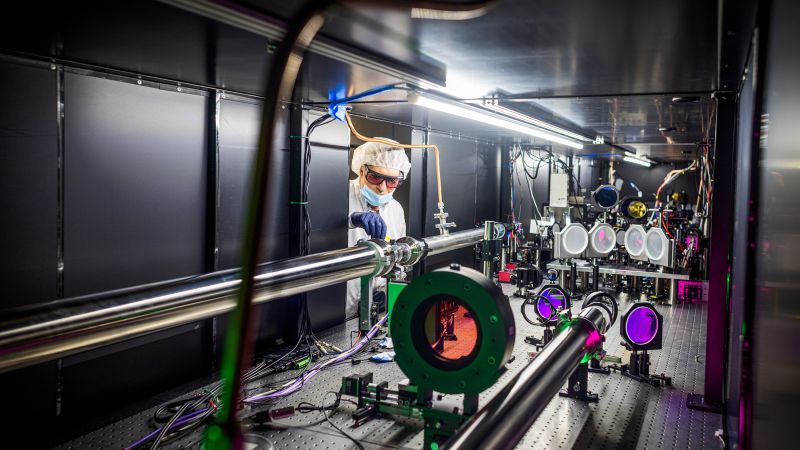
The U.S. National Science Foundation is investing $33 million in a scientific facility that will explore extreme states of matter using the highest-power laser in the U.S. The funding will enable full-scale operations of the NSF Zettawatt-Equivalent Ultrashort pulse laser System (NSF ZEUS). Over the next five years, NSF ZEUS will host dozens of research teams to conduct hundreds of experiments. Those experiments will make use of the facility's searing laser power, which is comparable in intensity to the average power of all the sunlight shining on the U.S. in a single day — but focused into an area smaller than the diameter of a human hair.
The results of such experiments are expected to reveal characteristics of matter and energy that have never been precisely measured or perhaps even observed. From high-energy particles that shoot out of black holes to gamma-ray bursts from exploding stars, scientists will use ZEUS to create similarly extreme conditions — but within a controlled laboratory environment. The resulting data will expand understanding of all sorts of natural phenomena, including quantum physics and astrophysics, and could lead to new ways to apply that understanding through new technologies for medical imaging, semiconductor production and other areas.
"At full power, NSF ZEUS will unlock a new class of experiments that cannot be done anywhere else in the United States," says NSF Mathematical and Physical Sciences Directorate Head Tie Luo. "Researchers across the country will use this versatile facility to test some of the most promising and innovative ideas involving light-matter interactions, plasma physics and the quantum properties of vacuum itself."
The ZEUS facility contains a variety of apparatuses to direct and control its multiple lasers for different sorts of experiments involving a wide range of targets. The targets are carefully prepared samples of matter in either solid, liquid, or gas form. When the laser strikes a target, it blasts away the electrons from its atoms and transforms it from its original state into a high-energy plasma. The resulting spray of particles, antiparticles, and energy is recorded and analyzed. In some experiments, scientists then calculate the plasma's properties based on how the target came apart and what it turned into. Other experiments aim to accelerate beams of particles to almost the speed of light, a feat which is currently done primarily by much larger and more expensive particle accelerator facilities.
One of the major goals of the ZEUS team is to conduct an experiment that will direct extreme-intensity laser light into a head-on collision with electrons traveling in the opposite direction. Accelerated by laser power to nearly (more than 99.999%) the speed of light, the electrons at the point of impact with the incoming laser will experience effectively one zettawatt of matter-rending power in a brief pulse lasting about one femtosecond. That's 1,000,000,000,000,000,000,000 watts in one millionth of one billionth of a second. The purpose of the experiment is to gain new understanding of the fundamental physical nature of the universe by observing what happens to electrons in such extreme conditions.
NSF is also investing $4.5 million in a new nationwide collaboration to enable precise measurements of high-power lasers, as well as the particles and light produced in laser experiments. ZEUS and other laser facilities use sophisticated instruments to measure and calibrate their lasers and optics and continue developing new diagnostic methods for studying the high-energy plasma produced by the lasers. But those instruments and methods vary from facility to facility. The NSF Diagnostics for Extreme-LIGHT (NSF DELIGHT) collaboration will develop a standardized set of instruments and software that any high-power laser facility and its users can rely on.
DELIGHT includes six complementary research projects, each led by institutions of higher education in six different states. The overarching goal is to improve the ability to make precise measurements at current and future high-power laser facilities, including the proposed NSF Optical Parametric Amplifier Line (OPAL) laser facility, which is now in the design stage. The effort is expected to help scientists better understand and compare results produced by different lasers and experiments. The DELIGHT collaboration will also help scientists use artificial intelligence more effectively to explore the vast amounts of data produced by those experiments.
NSF investments have transformed lasers into ubiquitous tools powering scientific exploration and our daily lives.
Learn more about the Lasers: The Power of Light