




U.S. Science, Technology, Engineering, Mathematics Talent
NSB publishes report on nation's STEM education, training, and workforce
Download a high-resolution version of this image
Science and engineering (S&E) is the new global currency of prosperity and power, and a strong science, technology, engineering, mathematics (STEM) workforce is the engine that drives the nation's S&E enterprise. A robust, relentless cycle of people making discoveries, innovating, and creating jobs fuels both the economic strength and the national security of the United States.
A new report, STEM Talent: Education, Training, and Workforce, published today by the National Science Board (NSB), provides high quality data to inform decision makers about U.S. STEM education and workforce trends, including how the U.S. compares with other countries.
"Developing America's STEM talent is one of the most strategic investments our nation can make," says Wanda Ward, who led NSB's review of the report. "The NSB is prioritizing the advancement of multisectoral initiatives to build the STEM workforce that the country needs, ranging from skilled technical workers to PhDs."
"These data give us reason for both optimism and concern," says Julia Phillips, Chair of NSB's Committee on Science and Engineering Policy. "For example, employment in STEM occupations grew at a faster rate than in non-STEM occupations between 2013 and 2023 and contributed to increasing shares of our country's workforce. On the other hand, distressingly, U.S. K-12 students continue to perform lower on average in math and science than students in other countries."
The STEM workforce is defined as those currently employed in S&E, such as engineers and software developers, S&E-related workers, such as registered nurses and pharmacy technicians, and STEM middle-skill occupations. Examples of middle-skill occupations include electricians and farmers, who require technical knowledge but are not classified as S&E or S&E-related and do not require a bachelor's degree.
Key U.S. Trends
- Employment in STEM occupations grew by 26% from 2013 to 2023, with STEM workers experiencing lower unemployment rates and enjoying higher median earnings than those in non-STEM jobs.
- In 2023, there were 36 million STEM workers in the United States, accounting for 25% of the total workforce.
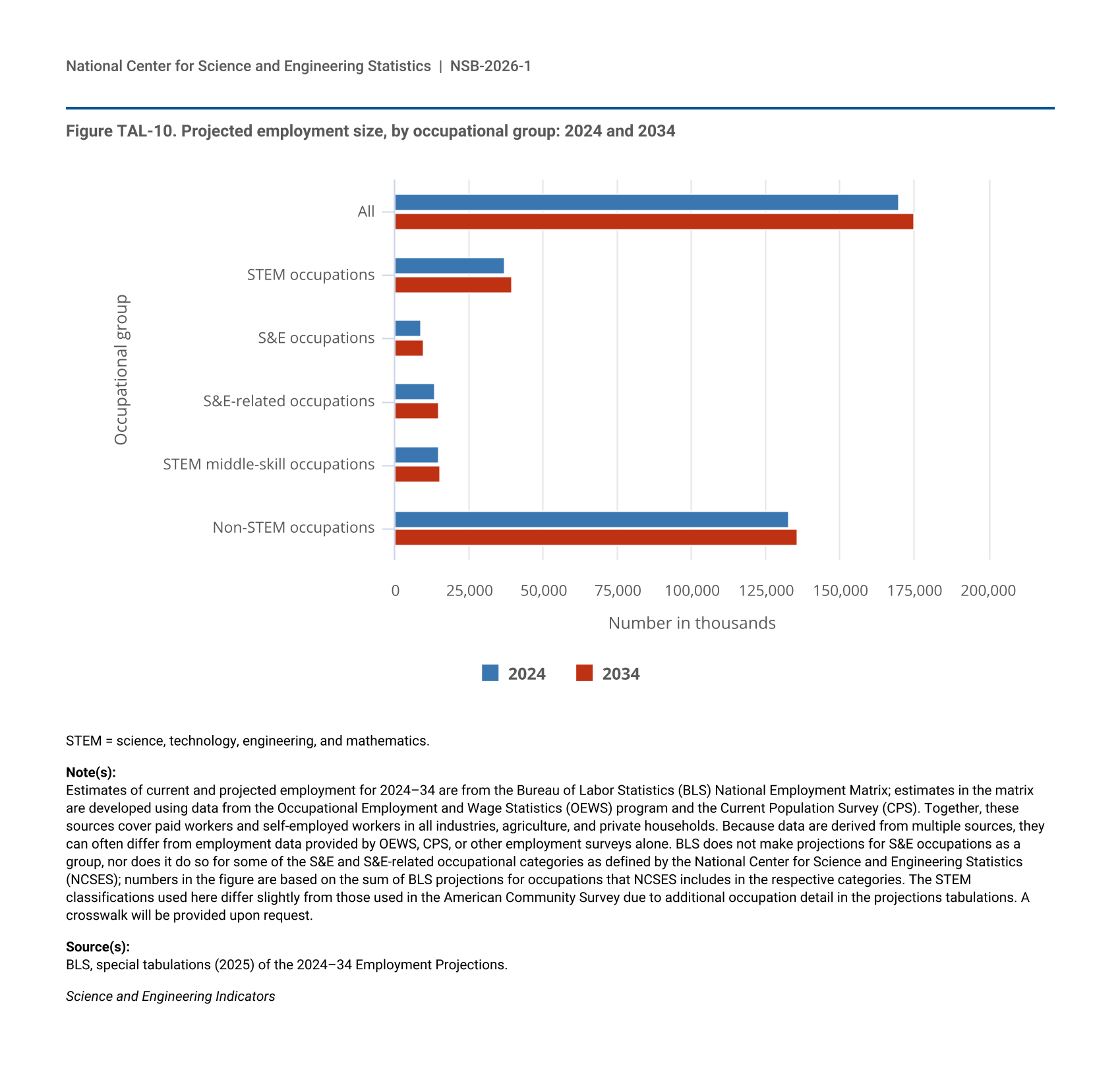
- Between 2024 and 2034, employment in the STEM workforce is projected to increase by 6% (compared to 3% for all occupations), with S&E occupations expected to grow the fastest (9%).
- Data science, information security analysis, and operations research analysis are projected to be the highest growing S&E occupations between 2024 and 2034.
- The professional, scientific, and technical services sector, and the information sector employed the highest shares of the S&E workforce (26% and 17% respectively). The health care and social assistance sector employed the highest share of the S&E-related workforce (43%). The construction sector (37%) and the agriculture, forestry, fishing, and hunting sector (35%) employed the highest share of the STEM middle-skill workforce.
- In 2023, the U.S. continued to attract the largest number of internationally mobile students worldwide, although its share of international students has dropped since 2017.
- In 2023, 22% of the U.S. STEM workforce was foreign born.
- In higher education, the number of students earning S&E master's and doctoral degrees reached new peaks between 2021 and 2023. In contrast, the number of students earning associate's and bachelor's degrees went down.
- In 2023, Computer and information sciences was the top field of study for associate's and master's levels. The top major at the bachelor's level was Social Sciences, and Engineering was the top major for doctorates.
- The U.S. awarded 45,000 S&E doctoral degrees in 2022. China awarded 53,000 S&E doctorates.
- Math performance among U.S. 4th, 8th, and 12th graders showed some learning recovery after the COVID-19 pandemic, but only for students in the highest performing percentiles.
- In 2024 math assessments, 8th graders taught by more experienced teachers, traditionally credentialed teachers, or with access to extracurricular enrichment activities performed better than students without such teachers or activities.
"Indicators data and trends reveal opportunities for public and private action to produce the robust STEM workforce our country needs to compete and prosper," says Phillips. "STEM workers are the backbone of our entire S&E enterprise. We must create more opportunities for domestic students to excel in and pursue STEM professions and simultaneously continue to attract and retain STEM talent from around the world."
STEM Talent: Education, Training, and Workforce, is part of the 2026 edition of the congressionally mandated Science and Engineering Indicators report on the on the state of the U.S. science and engineering enterprise in a global context. The Board previously published Discovery: R&D Activity and Publications and will publish two more 2026 Indicators reports, Translation to Impact: U.S. and Global Science, Technology, and Innovation Output, and the State of U.S. Science and Engineering, in April and May, respectively.
State-level data and other geographic analyses on mathematics and science achievement can be found in Science and Engineering Indicators: State Indicators. The U.S. National Science Foundation's National Center for Science and Engineering Statistics prepares Indicators under NSB guidance.
Learn more about the National Science Board
Learn more about the U.S. NSF's National Center for Science and Engineering Statistics
Media Contact: Nadine Lymn, National Science Board, (703) 292-2490, nlymn@nsf.gov