



New Mexico universities advance statewide manufacturing innovation initiative
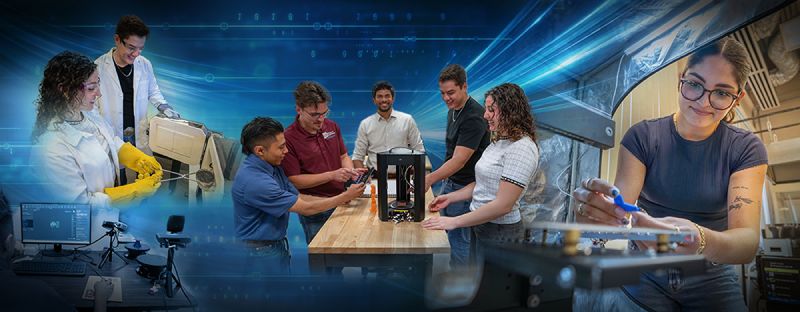
New Mexico's push to become a national leader in advanced manufacturing continues to gain momentum through the Center for Distributed Resilient and Emergent intelligence-based Additive Manufacturing (DREAM). The center is a statewide research initiative bringing together four institutions to build the future of distributed intelligent additive manufacturing.
Funded through the U.S. National Science Foundation Established Program to Stimulate Competitive Research (NSF EPSCoR) Research Infrastructure Improvement Program (E-RISE) funding opportunity, DREAM brings together research institutions with specialized expertise in cybersecurity, artificial intelligence, distributed networking systems, advanced manufacturing and industrial engineering. Its mission is to build the foundational cyberinfrastructure needed to bring distributed intelligent additive manufacturing to New Mexico and eventually to broader national applications.
Researchers involved in the project are developing scalable cloud-edge networking systems, cybersecurity and trust frameworks, and digital-twin technologies designed to support next-generation manufacturing environments and Industry 4.0 systems. The initiative also focuses on ensuring the verifiability and auditability of distributed manufacturing processes while building a distributed testing infrastructure capable of refining communication and operational systems in real time.
Consider a defense subcontractor, an oil and gas firm or an aerospace firm that needs to securely transmit proprietary 3D blueprint files to independent machine shops across the state to produce 3D replacement parts without risking intellectual property theft. Or imagine an automotive manufacturer using generative AI to design 3D-printed chassis and structural components. Rather than relying on a single centralized factory, the firm could securely stream print jobs to a network of micro-factories — smaller, specialized regional hubs — each producing distinct components that are ultimately stitched together into a complete vehicle.
This distributed model places manufacturing exactly where it is needed, dramatically reducing shipping costs and carbon footprints while keeping the full production ecosystem resilient and responsive. Across the automotive, aerospace, energy, medical, oil and gas, and semiconductor industries, scenarios such as these illustrate a fundamental shift in how physical goods are conceived, protected and produced; one in which digital assets must be made material with precision, security and accountability at every node.
This is precisely the challenge the DREAM Center was built to address. As Principal Investigator Jay Misra notes, "the center is already deploying AI to automate 3D printing and perform real-time quality assessment of prints — two capabilities essential for knitting micro-factories into a coherent, trustworthy production network." But realizing the full potential of distributed intelligent additive manufacturing requires more than just capital investment. It demands highly skilled technicians, secure networking for accessing protected designs, traceable bills of materials and reliable quality assurance at every step in the chain.
By building the foundational cyberinfrastructure to undergird this ecosystem, the DREAM Center aims to position New Mexico's small and medium manufacturers to become competitive global players in the industries that will define the next generation of American production. The effort outcomes from DREAM will serve as a blueprint for manufacturers nationwide to become competitive on the global stage. Through partnerships with universities, federal laboratories, industry leaders and community organizations, the initiative is helping establish New Mexico as an emerging hub for intelligent additive manufacturing innovation.
The DREAM initiative aligns closely with New Mexico's economic development and science and technology priorities by helping create a highly trained workforce while supporting efforts to expand domestic manufacturing capabilities. The project emphasizes education and workforce development through an integrated science, technology, engineering and mathematics pathway that begins in middle school and extends through doctoral and postdoctoral training. The initiative combines research experiences with educational models in several STEM fields.
The NSF E-RISE program supports the development of sustainable research infrastructure and workforce capacity in NSF EPSCoR jurisdictions through collaborative, hypothesis-driven and problem-driven STEM research initiatives designed to improve long-term competitiveness.
Collaborators: New Mexico State University, University of New Mexico, New Mexico Institute of Mining and Technology and Navajo Technical University