



Procedures for Handling Allegations of a Failure to Adhere to the U.S. National Science Foundation Scientific Integrity Policy
Purpose
This document outlines the procedures the U.S. National Science Foundation (NSF) uses to handle allegations of a failure to adhere to the agency's Scientific Integrity Policy.
Types of allegations within scope
An allegation that a covered individual (see the "Definitions" section below) may have failed to adhere to the NSF Scientific Integrity Policy can be submitted and reviewed through the procedures described in this document. The agency will seek to determine whether a loss of scientific integrity has occurred.
An allegation outside of the scope of the NSF Scientific Integrity Policy will be referred to relevant agency units or as otherwise appropriate, as described below.
Proposers and grant award recipients
Allegations against proposers and grant award recipients are outside of the scope of the procedures described in this document. The NSF Proposal & Award Policies & Procedures Guide contains information on scientific integrity expectations and requirements for proposers and grant award recipients, including but not limited to prohibitions against research misconduct, harassment, and discrimination.
Allegations of research misconduct should be reported to the NSF Office of Inspector General (NSF OIG) through the NSF OIG website hotline. Allegations of harassment or discrimination should be reported to the NSF Office of Civil Rights (NSF OCR).
Submitting allegations
An individual (the complainant) who witnesses or is aware of a situation that may constitute a failure to adhere to the NSF Scientific Integrity Policy should submit information within six months upon first learning about the incident. NSF will review anonymous allegations. However, the agency may be unable to update anonymous complainants.
An allegation must be made in good faith, meaning it is made with a reasonable belief that a loss of scientific integrity may have occurred. An allegation is not in good faith if it is made with reckless disregard for, or willful ignorance of, facts that would disprove the allegation. If there are indications that an allegation was not made in good faith, the matter will be referred to relevant agency units such as the NSF Workforce Relations Branch (NSF WRB).
Allegations should be submitted to the NSF Office of Scientific Integrity:
- By email: SIComplaint@nsf.gov.
- By mail: U.S. National Science Foundation, Office of Scientific Integrity, Randolph Building, 401 Dulany Street, Alexandria, VA 22314.
The Scientific Integrity at NSF page lists "What to include in the allegation submission."
Intake of an allegation
An allegation submitted to the NSF Office of Scientific Integrity will be received by the Executive Secretary of the Scientific Integrity Review Committee (SIRC). The SIRC Executive Secretary will inform the submitting individual (the complainant), if contact details are available, that the agency has received the allegation. The Executive Secretary will log the allegation in a manner to protect the confidentiality and privacy of all parties involved, including the complainant, to the extent possible and consistent with applicable law.
Initial referral of the allegation to the NSF Office of Inspector General
The SIRC Executive Secretary will forward the allegation to OIG. OIG may either assume jurisdiction and pursue the matter under its own investigative procedures (not described here) or refer the matter to SIRC.
Review by the Scientific Integrity Review Committee
If OIG decides to refer an allegation to SIRC, the committee will perform a review to determine whether to refer the allegation to other entities or to close the matter. SIRC aims to complete reviews of allegations within 120 days. SIRC does not have investigative authority, and it will not seek to obtain additional information from the complainant beyond what was shared in the allegation submission.
The Scientific Integrity Official (SIO) will serve as the SIRC Case Coordinator unless the NSF Office of the General Counsel (NSF OGC) determines that SIO has a conflict of interest. In that circumstance, the SIRC Vice Chair, a representative from NSF OGC, will serve as the Case Coordinator. Any SIRC members with conflicts of interest will be excluded from the SIRC review process until the allegation is closed or the conflict is appropriately managed in accordance with agency and federal conflict-of-interest rules. The SIRC and SIRC Case Coordinator may request the assistance of a subject matter expert to review the allegation when appropriate, taking conflicts of interest into account.
Allegations involving NSF leadership
OIG will oversee scientific integrity allegations involving NSF leadership, including but not limited to the NSF Director, Deputy Director, Chief of Staff, Chief Science Officer, and Chief Management Officer. OIG will adhere to the NSF Scientific Integrity Policy when a scientific integrity allegation falls outside the normal OIG scope and process.
Allegations not covered by the scientific integrity procedures
The Chief Science Officer, in consultation with SIO and OGC, will determine how to review types of scientific integrity allegations that are not covered by the procedures listed in this document.
"Information Quality Act"
Allegations that involve measures to correct scientific information in an NSF-generated or NSF-commissioned public document will be handled according to the requirements and procedures of the "Information Quality Act."
Closure prior to referral
If SIRC receives the allegation and determines that there is insufficient information to proceed with a referral, SIRC will close the matter. The complainant, if contact details are available, will be informed of the decision to close the matter due to insufficient information.
Referral by the Scientific Integrity Review Committee
If SIRC receives the allegation and determines that it contains sufficient information to proceed with a referral, SIRC will consult, as appropriate, with NSF OCR, OIG, and/or NSF WRB to determine who will review the matter. It is possible that the matter could be referred back to OIG at this stage. The review of an allegation will follow the procedures of the unit that receives the referral. The SIRC Case Coordinator will request to be kept informed by the relevant agency unit to the extent allowable according to agency policy and federal law and may assist the agency unit as appropriate.
Administrative or corrective actions
SIRC does not investigate allegations nor does it levy administrative or corrective actions. Administrative or corrective actions will be levied by the entity that investigates the allegation and/or by relevant agency or federal authorities if there is a finding that a loss of scientific integrity occurred.
Closure
A representative from SIRC will communicate with the complainant if contact details are available when the review of an allegation is concluded. To preserve privacy and confidentiality, identifying details about the matter, including which agency office(s) reviewed it, will not be provided to the complainant.
Submission of additional information by the complainant
If the complainant has additional substantive information to provide after being informed that the review of a previously submitted allegation has been closed, such information can be sent as an allegation submission to the NSF Office of Scientific Integrity email or mailing address.
Protections for complainants and employees
NSF shall seek to protect NSF employees and, as appropriate, other covered individuals who report allegations in good faith from retribution, retaliation, or reprisal. NSF will comply with federal whistleblower protections, including by protecting employees from prohibited personnel practices (as defined in 5 U.S.C. 2302(b)). NSF will seek to protect those who report in good faith an allegation of a loss of scientific integrity. NSF also will seek to protect NSF employees who allegedly failed to adhere to the NSF Scientific Integrity Policy in the absence of a finding that the allegation has occurred.
An allegation of whistleblower retaliation can be reported through the OIG Whistleblower Retaliation webpage or sent to the Office of Special Counsel.
Claims of alleged Prohibited Personnel Practices or violations of Merit Systems Principles can be reported to the Office of Special Counsel.
Case records and annual reports
Throughout the review of an allegation, the SIRC will keep careful documentation of the process. Except where disclosure has been formally authorized, all allegations, including the review, investigation, and disposition thereof, shall be treated as confidential, and all case records shall be collected, maintained, and safeguarded, in accordance with applicable privacy, information security, and federal records laws. Information about "Freedom of Information Act" (FOIA) requests can be found on the NSF FOIA webpage. The SIRC will prepare an annual report of the allegations it receives. The report will contain general, anonymized information.
Outline of the Scientific Integrity Allegation Process
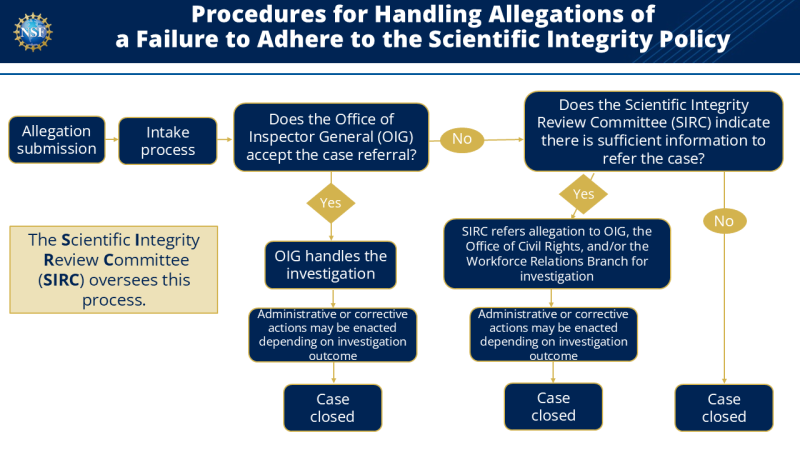
The above visual is simplified for ease of reference.
Procedures for handling allegations of a failure to adhere to the scientific integrity policy
- Allegation submission.
- Intake process.
- Does the Office of Inspector General (OIG) accept the case referral?
- If yes:
- OIG handles the investigation.
- Administrative or corrective actions may be enacted depending on investigation outcome.
- Case closed.
- If no:
- Does the Scientific Integrity Review Committee (SIRC) indicate there is sufficient information to refer the case?
- If yes:
- SIRC refers allegation to OIG, the Office of Civil Rights, and/or the Workforce Relations Branch for investigation.
- Administrative or corrective actions may be enacted depending on investigation outcome.
- Case closed.
- If no:
- Case closed.
- If yes:
- Does the Scientific Integrity Review Committee (SIRC) indicate there is sufficient information to refer the case?
- If yes:
Questions about scientific integrity at NSF
Questions, concerns, or a request for guidance related to scientific integrity should be sent to the NSF SIO at: sio@nsf.gov.
Definitions
Allegation refers to a report of a suspected loss of scientific integrity. An allegation must be made in good faith, meaning that it is made with a reasonable belief that a loss of scientific integrity may have occurred. An allegation is not in good faith if it is made with reckless disregard for, or willful ignorance of, facts that would disprove the allegation.
Covered individuals refers to persons who must adhere to the requirements of this policy, including NSF federal employees, contractors, "Intergovernmental Personnel Act" (IPA) assignees, political appointees, fellows, trainees, interns, ad hoc reviewers, detailees, volunteers, and special government employees (including but not limited to advisory committee members, merit review panelists, and site visitors) when they propose, review, or conduct science or communicate about science and scientific activities.
Inappropriate influence refers to the attempt to alter, delay, suppress, or interfere with scientific activities, communications, findings, or products without a reasonable scientific justification or by misusing one's authority in the workplace.
Loss of scientific integrity refers to a failure to adhere to professional practices, ethical behavior, or scientific integrity principles when conducting, managing, using the results of, or communicating about science or scientific activities. A loss of scientific integrity can result from inappropriate influence. Inappropriate influence refers to the attempt to alter, delay, suppress, or interfere with scientific activities, communications, findings, or products without a reasonable scientific justification or by misusing one's authority in the workplace.
Research misconduct refers to fabrication, falsification, or plagiarism in proposing or performing research funded by NSF, in reviewing research proposals submitted to NSF, or in reporting research results funded by NSF (45 CFR Part 689). Research misconduct does not include honest errors or differences of opinion.
Retaliation refers to, per 5 USC § 2302(b)(8), taking, failing to take, or threatening to take, personnel action with respect to any employee or applicant for employment because of any disclosure of information that the employee or applicant reasonably believes evidences violation of any law, rule, or regulation or gross mismanagement, a gross waste of funds, an abuse of authority, or a substantial and specific danger to public health or safety, or a disclosure of information that the employee reasonably believes is evidence of censorship related to research, analysis, or technical information and such censorship will cause a violation of any law, rule, or regulation or gross mismanagement, a gross waste of funds, an abuse of authority, or a substantial and specific danger to public health or safety, providing that such disclosure is not specifically prohibited by law and if such information is not specifically required by executive order to be kept classified in the interest of national defense or the conduct of foreign affairs (per Pub. L. 112-199, § 110).
Scientific integrity refers to the adherence to professional practices, ethical behavior, and the principles of honesty and objectivity when conducting, managing, using the results of, or communicating about science and scientific activities.
Scientific Integrity Official (SIO) refers to a senior career employee designated as an agency's lead to oversee implementation and iterative improvement of scientific integrity policies and procedures.
Scientific Integrity Review Committee (SIRC) refers to the working group charged by the NSF Chief Science Officer (CSO) to review allegations of a loss of scientific integrity and to make recommendations on whether to refer such allegations to relevant agency units or as otherwise appropriate. The SIRC assists other agency offices with scientific integrity matters as needed. SIRC members include: the SIO (Chair), a representative from OGC (Vice Chair), the SIRC Executive Secretary, a representative from the Office of the Chief Human Capital Officer (OCHCO), a representative from the Office of Financial Assistance Requirements, and Program Director(s). Additional agency staff may serve as subject matter experts as needed. SIRC members are bound by the Standards of Ethical Conduct for Employees of the Executive Branch, NSF Manual 15, "NSF Conflict of Interests Rules and Standards of Conduct," and NSF PER Manual Chapter 1, Subchapter 100 – Personnel Management Policy.