



NAIRR at 2 years: Advancing American artificial intelligence innovation and leadership
Two years after its launch, the National Artificial Intelligence Research Resource (NAIRR) is demonstrating how a national approach to artificial intelligence infrastructure can expand opportunity, accelerate discovery and fuel U.S. leadership in AI innovation. What began as a pilot initiative is now enabling researchers, educators, students and innovators across the country to access advanced AI resources. In doing so, NAIRR is driving innovation, fueling economic growth and reinforcing American leadership in emerging technologies.
Led by the U.S. National Science Foundation, in partnership with 13 federal agencies and 28 private-sector contributors, NAIRR is building a scalable, national infrastructure designed to support the entire U.S. scientific community, including researchers, educators, students, startups and small businesses. By providing access to world-class AI computing, data, tools and training opportunities, NAIRR enables researchers across the country to contribute to the AI innovation ecosystem, regardless of their geographic location. In addition to expanding research capacity, NAIRR provides students and educators with hands-on opportunities to use AI resources, strengthening the pipeline of an AI-ready workforce.
NAIRR is founded on public-private collaboration. By combining federal investments in early-stage, high-risk research with access to private sector state-of-the-art AI tools, NAIRR accelerates innovation beyond what a single company or government agency could achieve independently. This model shortens the path from foundational research to deployable AI applications, producing innovations that strengthen U.S. economic competitiveness.
Acting as a force multiplier for academic research groups, startups and small businesses, NAIRR helps translate federally funded research into measurable economic and societal impact. It aligns with the White House's AI Action Plan and has been recognized by the White House Office of Science and Technology Policy in its one-year S&T wins. Through this collaborative approach, NAIRR contributes to a national AI ecosystem that advances innovation across key economic sectors, prepares the next generation of AI-ready workers, and ensures the United States remains competitive in the global AI race.
Since 2024, NAIRR has supported more than 600 research teams and 6,000 students across all 50 states, Washington, D.C. and Puerto Rico. These teams have gained access to advanced computing platforms, high-quality datasets, software, models, educational and support resources. For many teams, this access has enabled research that would otherwise have been difficult or impossible to conduct.
The breadth and impact of this work are captured in the NAIRR 2-year progress update, which highlights measurable outcomes across research, workforce development and economic impact.
The projects highlighted below illustrate how access to NAIRR's resources is translating foundational research into measurable, real-world benefits.
Training Vision-Language Models for Agricultural Resilience
Researchers at the AI Institute for Resilient Agriculture are using NAIRR computing resources to train and evaluate a large vision-language machine learning model for quickly identifying agricultural pests, including insects, weeds and plant diseases. Trained on the ARBORETUM dataset, which includes more than 134 million paired images and text descriptions, the model goes beyond image-only tools to make more accurate and useful identifications. By improving early detection and response, this research helps farmers and agricultural researchers protect crops, reduce losses and respond more effectively to emerging threats.
Automated Brachytherapy Planning for Cervical Cancer
Researchers at UC San Diego are using NAIRR high-performance computing resources to develop an AI model to support cervical cancer treatment planning, specifically brachytherapy. The model analyzes images of tumors alongside nearby organs to evaluate and predict the impacts of treatment plans on tissues surrounding the treatment site. By enabling faster and more accurate treatment plants, this research can contribute to reducing patient discomfort, risks of human error, and help standardize care across clinics facing specialized staff and other resource constraints.
Investigating Security Issues in Instruction-Tuned Large Language Code Models
Using NAIRR's high-performance computing resources, researchers at the University of Louisiana at Lafayette are investigating the security risks of AI coding assistants — tools that automatically generate software from instructions. The team developed MalInstructCoder to test whether these AI coding assistants could be subtly manipulated to insert hidden malicious code while producing outcomes that appear normal. The team uncovered a new cybersecurity risk: attacks that target AI systems themselves rather than the software they produce. Understanding these vulnerabilities is essential for the safe deployment of AI tools across commercial, infrastructure and national security environments.
NSF National Deep Inference Fabric
The NSF National Deep Inference Fabric at Northeastern University will provide U.S. researchers with unprecedented insights into how large language models process information internally. Using NAIRR resources and the high-performance DeltaAI cluster at the National Center for Supercomputing Applications, researchers will be able to explore these models’ internal computations. By making large-scale AI systems more transparent, this project will help the scientific community deepen its understanding of AI systems and advance the next generation of AI innovation.
KnotGym: A 3D simulation environment for spatial reasoning
This NAIRR startup allocation to Cornell University supports KnotGym, a 3D virtual environment designed to evaluate how well AI systems understand and manipulate physical objects. In KnotGym, models analyze images of ropes and knots and attempt to untie, tie or transform them. Using NAIRR's high-performance computing resources, researchers trained and evaluated multiple AI approaches across a variety of knot types. The results showed that while AI performs well on simple untying tasks, performance declines as knots become more complex, revealing limitations that will guide future advances in robotics and automation. Their work was presented at the "Thirty-Ninth Annual Conference on Neural Information Processing Systems," a prestigious annual AI conference.
The NAIRR annual meeting
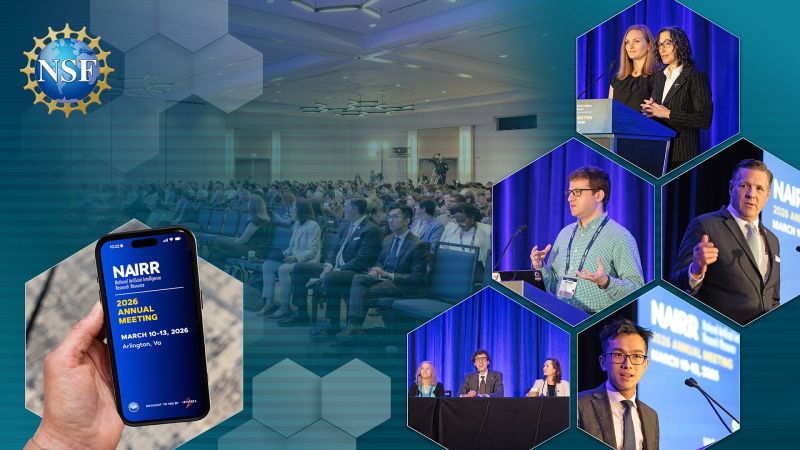
From March 10-14, 2026, more than 600 researchers, educators, resource providers, and students convened in Crystal City, Virginia, for the NAIRR annual meeting. The meeting brought together a community of researchers, students, educators and providers to highlight advances in AI-enabled science and engineering across multiple disciplines. The event featured keynote presentations, poster sessions and demonstrations to share research highlights and experiences using NAIRR tools and resources. It also created opportunities for collaboration and feedback between researchers and infrastructure providers, helping inform the continued development of NAIRR capabilities.
Looking ahead: Expanding access through regional NAIRR hubs
Building on insights from the pilot and conversations with industry, philanthropic and academic partners, NAIRR is exploring opportunities to expand training and workforce development through potential state or regional "hubs." These hubs would combine advanced computing and data platforms with hands-on instructional programs, providing students and educators with practical experience using AI systems and expanding access to NAIRR resources across a broad range of institutions. Initial conversations on this topic have taken place among members of the industry/philanthropy community and the academic scientific computing community.
As NAIRR enters its next phase, the focus shifts from pilot-scale deployment to a sustained national capability. NAIRR will institutionalize shared AI research infrastructure as a durable public asset — supporting high-risk, high-reward research, empowering educators to train the next generation, and accelerating innovations aligned with national priorities. This transition establishes NAIRR not simply as a program but as a core component of the U.S. AI innovation ecosystem, reinforcing American leadership in AI research, deployment and real-world impact.