




A groundbreaking software that simulates Earth's mantle advances knowledge in surprising ways
Community-developed software helps researchers model tectonic plates, uncover energy resources and study geological mysteries from Earth to Saturn's moons
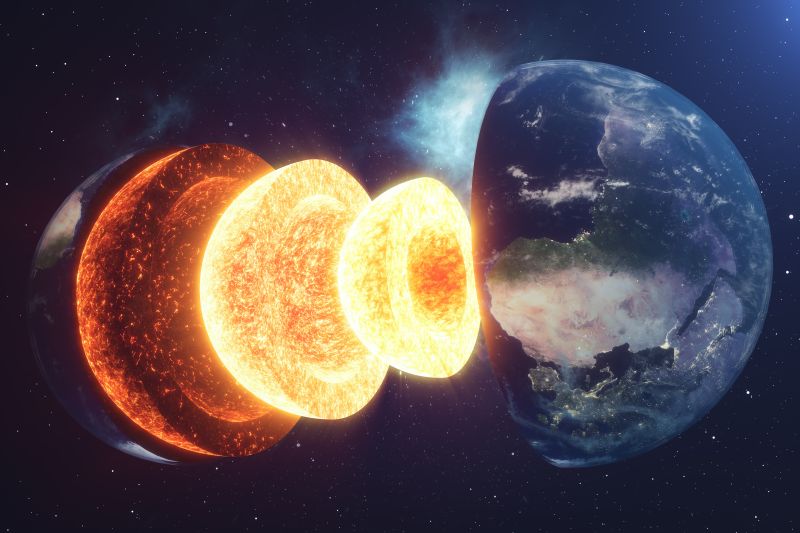
The Earth's mantle makes up most of the planet, filling 85% of its volume and accounting for 70% of its mass. However, researchers cannot directly measure this thick, viscous layer as it lies miles beneath Earth's crust, under extreme heat and pressure.
Instead, scientists often use advanced software, among other tools, to model and visualize the mantle's complex processes. The U.S. National Science Foundation invested in the Computational Infrastructure for Geodynamics (CIG), a "community of practice" that advances Earth science by collaboratively developing and disseminating software for geophysics and related fields. Since its inception over 20 years ago, CIG has evolved to incorporate more complex models, implement new numerical methods and train new users.
Early on, an interdisciplinary CIG community developed Advanced Solver for Planetary Evolution, Convection, and Tectonics (ASPECT), an open-source software used to simulate what happens in Earth's mantle and lithosphere. Scientists use ASPECT to better understand how and why tectonic plates move on Earth's surface, revealing economically important and scientifically groundbreaking discoveries along the way.
Finding a way to discover new energy sources
Natural hydrogen gas can be generated in several ways, including bacterial processes and radioactive decay. But large quantities occur where hydrogen is generated through geological reactions.
A team of scientists, using ASPECT, developed a novel approach to searching for hydrogen hotspots, opening new avenues to bolster energy supplies and support economic growth.
To reach this discovery, the researchers ran the model to determine where, when and how rocks from Earth's mantle rise during the mountain-building process. Next, they determined when and where those rocks react with water to generate hydrogen.
The team published a paper showing how certain mountain ranges, especially those with rocks that originated in the upper mantle, are more likely to be natural hydrogen hotspots than rift basins, or depressions in the Earth's crust.
"The findings provide a guide to identify economically important geologic features," said Raleigh Martin, an NSF program officer, " and highlight the impact of NSF-supported resources."
Exploring processes on Earth and beyond
Plateaus that jut out like stubby toes across rolling landscapes had long puzzled researchers, until they turned to ASPECT.
Using the software, a research team recreated mantle conditions after continental breakups, such as when North America split from Europe millions of years ago. They found that mantle convection, the process that moves continental plates, also produces a very slow horizontal ripple that moves beneath the continents.
These ripples scrape off rock and eventually leave behind a lighter region of the continent that rises as a plateau about 1–2 km high. The team published a paper upending the idea of stable continental interiors.
In another study, researchers proposed a new idea to explain why narrow pipes of magma that carry diamonds to Earth's surface are found in the quiet interiors of continents rather than near the more eruptive edges of tectonic plates or near mantle plumes, which form hotspots like Hawaii and Yellowstone.
The team used ASPECT to determine that diamond-bearing eruptions are the after effects of supercontinent breakups. These breaks cause swells that ripple through the mantle, travel hundreds of kilometers over millions of years, and occasionally trigger an explosion where it seems least likely.
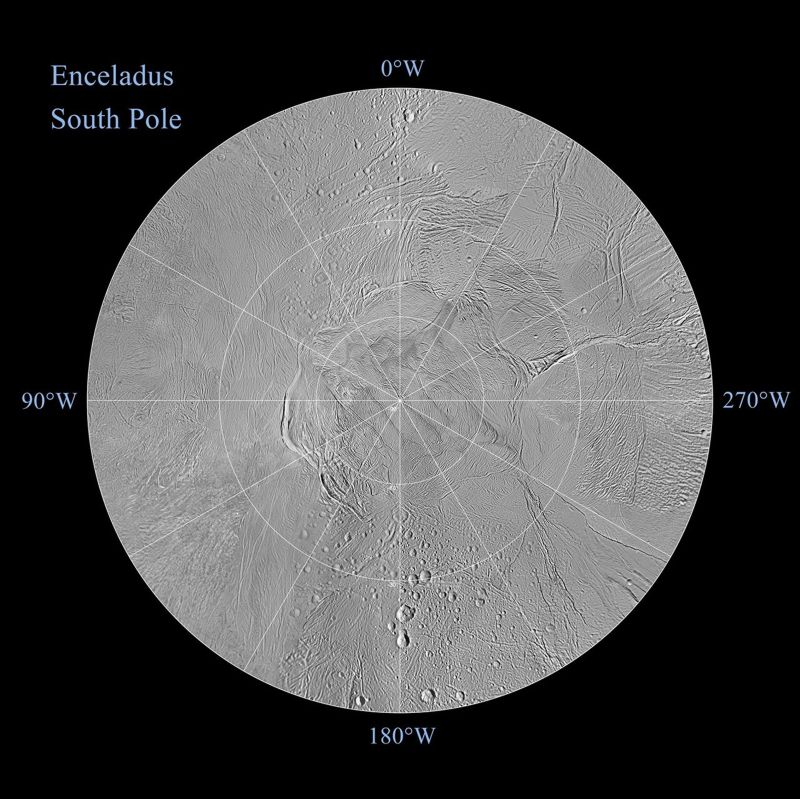
A different team of researchers used another software in the CIG portfolio, called PyLith, to study an interesting feature far away from Earth — "tiger stripe" faults on Enceladus, an icy moon of Saturn. The team characterized the motion of the faults and provided new insights into what causes jets of icy particles to spray out from jagged, 150-kilometer-long faults at Enceladus's south pole. Scientists believe the moon harbors a global ocean beneath its icy crust.
The team published its findings, helping create a detailed picture of Enceladus's potential habitability over time.
Building a workforce versed in Earth and computer sciences
Beyond groundbreaking, economically important research, CIG has trained many researchers who have gone on to jobs in a variety of sectors, from academia to industry. CIG's unique approach to combining Earth sciences and computational sciences equips the workforce to apply leading-edge numerical methods to tackle real-world problems.
"The ASPECT community has been an important model not only for CIG but for other disciplines in training researchers to interact with and contribute to open-source software, skills which are highly valued by employers," said Lorraine Hwang, co-director of CIG based at the University of California, Davis.
CIG helps researchers develop and share high-quality, open-source scientific software for geophysics and hosts training efforts to prepare the future scientific workforce. The community that has formed around ASPECT, for example, hosts multiday hackathons to encourage new users, connect users with experts and promote collaboration.