




New state of matter could aid quantum computing
In between two of nature's most common crystal structure types is a state of matter that exists for a tiny fraction of a second.
Researchers supported by the U.S. National Science Foundation have now captured this ephemeral state of matter using silver nanoparticles instead of atoms. The newly observed nanocrystal superlattice has extraordinary optical properties that could be useful in quantum information systems and pave the way to develop new materials with tailored properties.
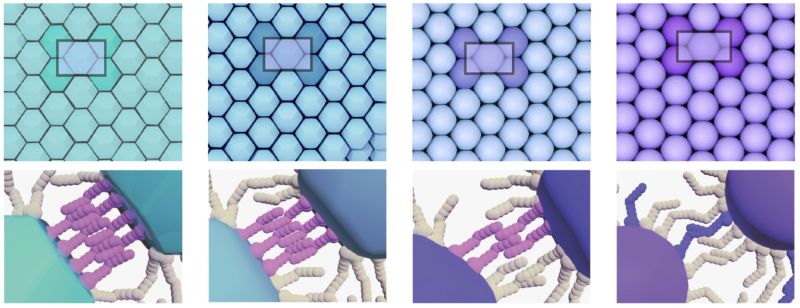
For many metals, the atoms are arranged in two types of crystal structure categories: face-centered cubic (FCC) or body-centered cubic (BCC). FCC describes more tightly packed arrangements of atoms than BCC, and with some heating, some metals transition between the two structures. One pathway for this transition is called the Nishiyama-Wassermann pathway, a theory that this study confirms.
The research team created a range of silver nanocrystals in truncated octahedron shapes, which have14 faces, and coated them with long, sticky molecules to help them bind together. The researchers then allowed the crystals to self-assemble into nanocrystal superlattices — 3D, ordered nanoscale architectures built from nanocrystals rather than atoms.
The team used both physical observations and computer simulations to discover that the sticky molecules allowed the nanocrystals to assemble themselves in ways that matched the transient state of matter.
The silver nanocrystal superlattices are stable in this intermediate arrangement and demonstrate properties like deep-strong light-matter coupling. In deep-strong light-matter coupling, the collective electron oscillations of the silver nanocrystals and the light field mix so completely that the resulting state can no longer be described as either light or matter.
Achieving this effect normally requires extreme conditions, including cryogenic temperatures or a precisely engineered nanoscale cavity. In this study, the structure assembled itself easily on the laboratory benchtop and supported the effect at room temperature. The work provides a blueprint for future research using custom-shaped nanocrystals to engineer new materials for quantum technologies.
Read the full story.