




Researchers identify new source of gamma rays released during solar flares
Researchers supported by the U.S. National Science Foundation discovered a source of intense gamma rays released during solar flares, offering a new insight that could enhance space weather forecasting.
The team identified a previously unknown group of high-energy particles in the sun's corona — the outermost part of the solar atmosphere — as responsible for generating the intense gamma rays during major solar flare events. Gamma rays are the most energetic form of electromagnetic radiation; they can escape into space and contribute to space weather activity, which can damage technological infrastructure and services.
"We knew solar flares produced a unique gamma-ray signal, but that data alone couldn't reveal its source or how it was generated," said Gregory Fleishman, the lead author and distinguished research professor at the New Jersey Institute of Technology (NJIT), in an institute release. "Without that crucial information, we couldn’t fully understand the particles responsible or evaluate any potential impact on our space weather environment."
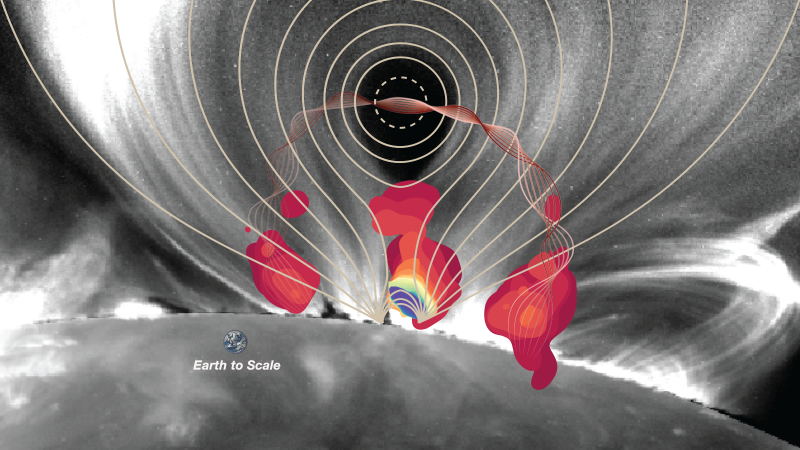
The team studied a powerful solar flare that erupted on Sept. 10, 2017, using data from NASA's Fermi Gamma-ray Space Telescope and the NSF Expanded Owens Valley Solar Array (EOVSA), a state-of-the-art solar radio telescope array led by NJIT in California.
Combining Fermi's measurements of high-energy gamma-ray emissions with EOVSA's measurements of radio emission from accelerated particles in the sun's corona, the researchers were able to identify a distinct region in the solar atmosphere where the two kinds of signals converged. In that region, the team observed trillions of particles energized to several million electron volts. These particles were hundreds to thousands of times more energetic than typical flare particles, matching the same energy distribution required to generate the observed gamma-ray signals.
The team looks forward to future studies once EOVSA completes its NSF-supported upgrade, which involves installing six new antennas and advanced ultrawideband feeds. The new tools will help the researchers better understand how particles accelerate and move in solar flares.