




Space weather impacts on GPS extend to polar regions, expanding on ionospheric research to mitigate future disruptions
Researchers supported by the U.S. National Science Foundation published new findings detailing how geomagnetic storms can create large risks of errors in Global Positioning System measurements in polar regions. This work was built on previous research that linked a major geomagnetic storm in May 2024 to malfunctioning GPS-enabled tractors in several Midwestern U.S. states, which cost farmers hundreds of millions of dollars.
The new research revealed risks that extended across sectors that heavily rely on GPS in polar regions, including aircraft, ships and oil rigs. The previous and new research efforts support work to mitigate future space weather risks, which can disrupt GPS signals and impact electric power grids and satellite systems.
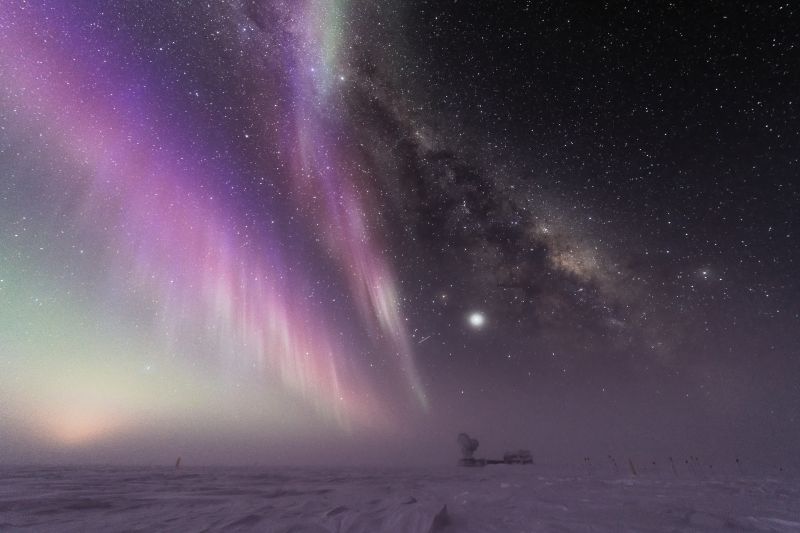
Researchers showed that in the polar regions, the risk of GPS position errors is higher because fewer satellites are located overhead. Additionally, strong auroras may disturb the polar ionosphere, making GPS signals even more vulnerable.
Researchers also found that during the May 2024 solar-geomagnetic storm, an ionized region of Earth's upper atmosphere, the ionosphere, became disturbed, interfering with GPS signals.
Those different types of ionospheric disturbances led to large errors in GPS position solutions, even when a sufficient number of satellites were available.
Expanding ionospheric research
This work builds on the team's earlier study of the May 2024 event that impacted GPS-enabled tractors in the Midwest. That research helped correct GPS errors and improve real-time forecasting of GPS reliability by showing that the geomagnetic storm — driven by charged solar particles — created unusually strong plasma disturbances, causing errors in GPS signals passing through.
Although there had been similar geomagnetic storms in the past, it wasn’t until the May and following October 2024 storms that the team observed significant position errors. The researchers connected with affected farmers, who reported that their GPS-enabled tractors veered off course by 10 to 20 meters or completely lost GPS positioning information, leading to hundreds of millions of dollars in lost revenue because certain crop planting was disrupted or delayed.
The team drew on data from the NSF National Geophysical Facility, a nationwide network of fixed GPS receivers installed across the U.S. The facility supports studies of Earth's tectonics and geodesy, and in this case, space weather effects.
The research reveals GPS's vulnerability to space weather events and informs new ways to mitigate future impacts. The team is exploring machine learning techniques to forecast where irregularities could emerge during geomagnetic storms, as well as other methods, such as incorporating reference stations to improve GPS position accuracy.