



NSF funds polymer research center with nearly $20M investment
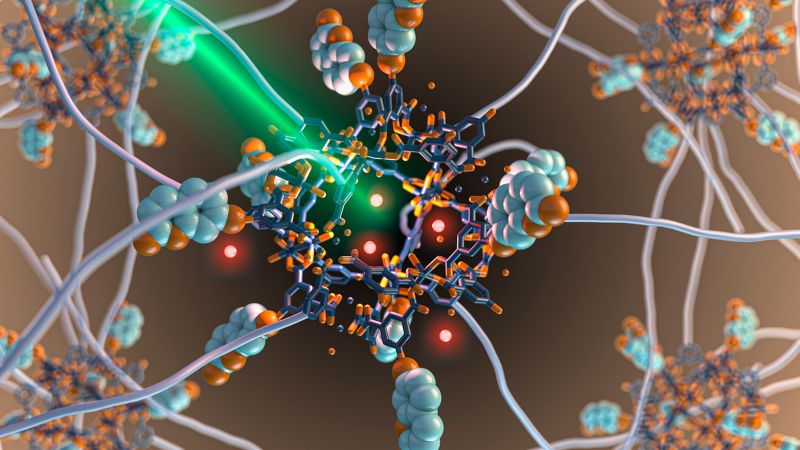
The U.S. National Science Foundation is investing $19.8 million in a research center exploring the science of polymer networks: long, repeating molecules found in all sorts of things, from trees to tires to plastics. The NSF Center for the Chemistry of Molecularly Optimized Networks (NSF MONET) will receive the funding over five years from the NSF Centers for Chemical Innovation program, which focuses on major challenges in fundamental chemistry that require substantial teams and years of effort.
NSF first provided seed funding to NSF MONET in 2018 and later scaled it up in 2021. With the new five-year investment from NSF, MONET will continue to advance its pioneering work on complex networks of polymer molecules.
"From life-saving medicines to the rubber in your vehicle's tires, everyday life is powered by chemistry research," says NSF Mathematical and Physical Sciences Directorate Head Tie Luo. "Polymer networks are a promising frontier, and this NSF Center for Chemical Innovation will help uncover how they work and reveal new ways to strengthen America's economy and quality of life through foundational science."
The properties of polymer networks are exceptionally challenging to understand and predict because every molecular twist, turn and tangle interacts dynamically with others. NSF MONET has made substantial progress in understanding the oftentimes counterintuitive properties of these networks. For example, NSF MONET published new findings in June showing that the impact resistance of some common polymers could be strengthened, paradoxically, by creating weaker bonds within the material, thus allowing energy to dissipate with less damage.
NSF's investment will support research at eight institutions of higher education across seven states. NSF MONET will also educate and provide specialized training for more than 30 students and early-career researchers, as part of NSF's mission to support and grow the U.S. scientific workforce.
The NSF Centers for Chemical Innovation have collectively produced thousands of new findings and innovations, from AI-based systems that accelerate the speed of chemical discoveries to modifying the building blocks of proteins to achieve useful properties for drug development and biomaterials.
NSF has invested in 15 Centers for Chemical Innovation since the program's inception in 2007. Six such centers are currently supported by NSF.