

Organization(s)
Led by the U.S. National Science Foundation, Project Triad will seize opportunities and create strategic advantages for the U.S. by integrating three domains of quantum technology — sensors, computers and networks — in a unified, functional system.
NSF Project Triad brings together industry, academia and government to demonstrate the potential of an integrated quantum system for real-world applications that span safety, healthcare, energy, manufacturing and more.
 On this page
Project Triad's goals

Enable uniquely powerful scientific and technological capabilities to benefit America's economic competitiveness, national security and quality of life.

Build the scientific and technological foundation for integrated quantum systems to be refined, scaled up and deployed by U.S. industry.

Strengthen America's global leadership in quantum information science, engineering and technology.
NSF Project Triad will unite the research enterprise to advance the Administration's vision ensuring public investments translate into strategic advantages in quantum technology for all Americans. Project Triad, in alignment with the executive order on Ushering in the Next Frontier of Quantum Innovation, continues NSF's leading role in advancing innovation that improves American prosperity, quality of life, national security, and creates jobs for American workers.
Why Project Triad is needed now
As global competition in quantum science and technology increases, Project Triad provides a viable path for the U.S. to unlock unprecedented new capabilities.
Computer chips have become more powerful over the last several decades by packing more and more transistors in each chip, but that previously rapid improvement has now slowed. That's because current technologies are based largely on classical physics and are constrained by power consumption, cooling capacity and fundamental physical limits.
However, emerging technologies based on quantum mechanics are not subject to some of those limitations — and can potentially do what even the most advanced classical technology never could.
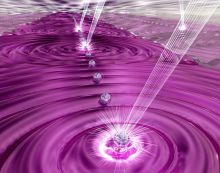 Classical vs quantum
In the early 1900s, scientists developed quantum mechanics to explain observations that defied classical physics. For example, they saw that electrons and other tiny particles have distinct levels, or quantities, of energy — but never any quantity in between those levels. This quantization is one of several properties described by quantum mechanics. Others are entanglement and superposition. Some technologies like magnetic resonance imaging (MRI) and atomic clocks already use quantum properties, and many more are in development.
What's an integrated quantum system?

Credit: Alice Kitterman/U.S. National Science Foundation
Project Triad will create the first-ever system where quantum sensing, networking and computing work together in concert. These technologies all make use of quantum properties in particles of matter and energy, like atoms and photons.
Project Triad will create an information gathering, transmission and processing environment that maintains the quantum coherence of information throughout the entire system. This is an integrated quantum system — and it's the key to making a wide range of emerging quantum technologies do truly useful things.
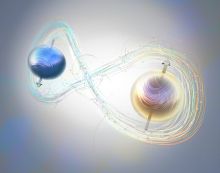 Quantum coherence
The "quantumness" of a system depends on maintaining what is called quantum coherence. That means, for example, that entangled particles stay entangled. Otherwise, information is lost and a previously-quantum system becomes no more useful than a classical one. Maintaining quantum coherence is akin to maintaining the electrical conductivity of the wires in your house. If they lose that conductivity, electricity can't flow — and your refrigerator stops working.
Potential applications for integrated quantum systems

Navigation and communications
Navigation and secure communications for first responders or military personnel operating in areas without access to GPS or other satellites.

Oil, gas and mineral detection
Detecting underground oil, gas and mineral deposits with less exploratory drilling.

Precision agriculture
Dynamic measurement of agricultural crops to allow pinpoint applications of chemicals and more efficient use of irrigation.

Individualized medicines
Precise medical imaging and diagnostic data to produce individually-tailored medicines that effectively treat a range of illnesses.

Earth hazards forecasting
Measuring Earth activity to simulate the likelihood of earthquakes and volcanic eruptions.

Better, safer materials
Advanced new materials, including those with embedded sensors enabling real-time monitoring of stress, temperature and other factors.
Achieving Project Triad will require exceptional fundamental scientific work alongside translational research to utilize quantum data to its utmost.
De-risking new technology
The benefits of scientific discovery and innovation are generally reaped predominantly by the country that achieves them first and develops them best.
While being first has benefits, it also has risks. For example, a company might invest substantial time and resources in a new technology that seems promising initially but ultimately does not succeed (remember 8-track tapes?).
Project Triad will mitigate such risks by providing a way for new methods and ideas to be rigorously explored and evaluated. That information will be used to judge the technological and financial feasibility of new ideas. Ideas that would have otherwise led to a dead end will be discarded early on, allowing other ideas to be identified as worthy of additional testing and development.
That process is called de-risking, and it reduces the otherwise prohibitive financial risks and uncertainties involved in scaling up and manufacturing new technologies. Project Triad will de-risk many new methods and ideas, allowing researchers and industry to efficiently home in on the most viable breakthroughs that can be fast-tracked from the lab to commercial deployment for real-world applications.
Programs and partners
NSF National Quantum Virtual Laboratory (NSF NQVL)
NSF NQVL will deliver Project Triad's proof-of-concept integrated quantum system for experimentation and testing. Now in the design phase, NSF plans to accelerate several NQVL projects from design to implementation by December 2026, subject to the availability of funds.
NSF X-Labs
NSF X-Labs are independent teams of researchers, engineers and entrepreneurs pursuing milestone-based federal funding to solve specific scientific challenges, including quantum systems involving interconnects and photonics. Such technology will play a critical part in enabling integrated quantum systems to transfer quantum information between devices.
NSF Quantum+X
NSF Quantum+X will work directly with industry to identify promising use cases and potential applications for integrated quantum technology. NSF is now actively seeking partnerships for the launch of an initial set of Quantum+X funding tracks that could span the energy, finance, biotechnology and pharmaceutical sectors, among others.