



Quantum computing: Expanding what's possible
From designing life-saving medicines to securing digital communications, quantum computers could allow us to solve problems too complex for today's most powerful computers.
The bottom line
- Quantum computers aim to solve highly complex problems by using the properties of tiny particles, like atoms, to process information.
- Their realization could accelerate the development of life-saving medicine, optimize global supply chains, advance material science and secure digital infrastructure.
- U.S. National Science Foundation funding drives breakthroughs that are enabling new quantum technologies while providing specialized training and education for American scientists and engineers.
What is quantum computing?
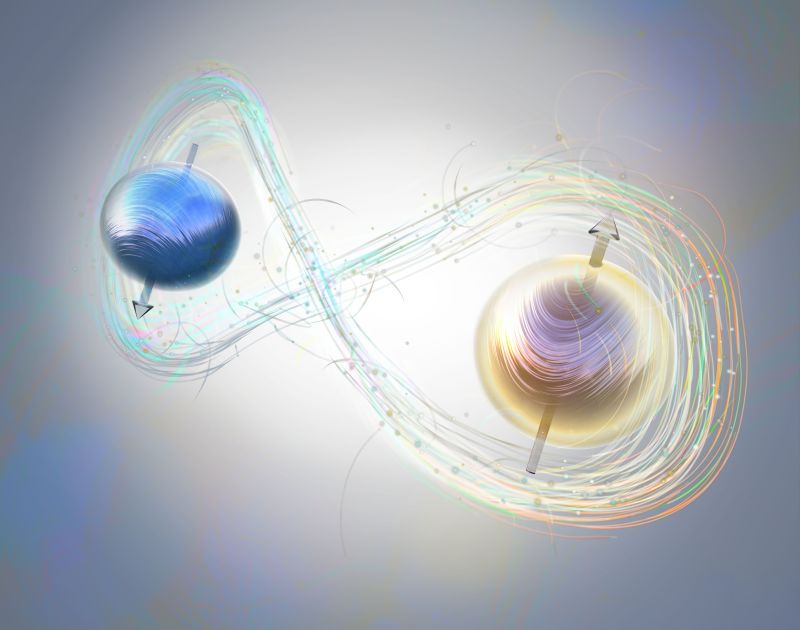
Unlike classical computers that process information using bits (0s and 1s), quantum computers employ qubits, which use the principles of quantum physics — the science of how matter and energy behave at the tiniest scales — to represent information in entirely new ways. Qubits can exist in a superposition of multiple states, meaning they can be in state 0, state 1, or a mix of the two. They can also become entangled with each other, allowing them to exhibit "spooky" correlations across vast distances.
This combination of superposition and entanglement enables quantum computers to perform numerous calculations in parallel, dramatically increasing computing power and making them potentially capable of solving problems that are far too complex for classical computers.
Quantum computing relies on more than just the computers themselves. Its full potential depends on a connected ecosystem of quantum computers to perform calculations, quantum networks to transmit information, and quantum sensors that capture precise details from their surroundings. Together, these technologies could enable networked quantum computers to run advanced simulations using real-world data, opening the door to discoveries beyond the reach of today's most powerful computers.
Why is quantum computing important?
Quantum computing could accelerate discovery in areas where complexity overwhelms classical computation, such as simulating the behavior of molecules for drug discovery, solving optimization problems in logistics or supply chains, creating new superconducting materials, improving weather forecasts, and developing ultra-secure communication protocols rooted in quantum cryptography.
What opportunities remain?
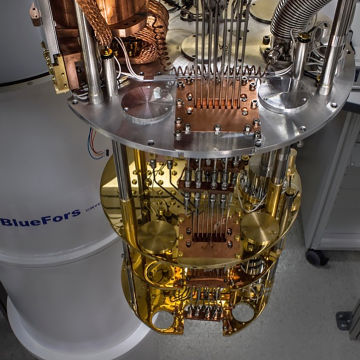
Quantum computing is in an experimental stage and requires highly specialized equipment, extremely cold temperatures and extraordinary precision. Despite remarkable progress, qubit-based computing is fragile and prone to errors, making it difficult to scale systems to hundreds or thousands of qubits while maintaining reliable performance. In addition, developing algorithms that can fully harness quantum hardware and integrating quantum and classical systems adds another layer of complexity. Yet, NSF-funded research is steadily overcoming these obstacles by advancing error correction, developing new qubit technologies and training next-generation quantum scientists and engineers — bringing the promise of practical quantum computing closer to reality.
NSF's investments in quantum computing
Laying the groundwork
NSF has been at the center of quantum computing breakthroughs for decades. In the mid-1980s, NSF-funded researchers demonstrated that quantum tunneling, previously seen only in subatomic particles, could occur in a superconducting electrical circuit visible to the naked eye. This showed that circuits could behave as quantum objects, opening the door to engineered quantum computers and later earning the 2025 Nobel Prize in physics.
About a decade later, NSF-supported researchers advanced the field again by creating the first Bose-Einstein condensate, a state of matter where thousands of atoms act as a single "superatom." This breakthrough made it possible to study quantum phenomena on a macroscopic scale, unlocking new ways to understand quantum behavior and earning the 2001 Nobel Prize in physics. In the early 2000s, NSF helped launch research into topological materials, whose unique properties can help keep quantum information intact. This work was a key step in the ongoing work to create materials-based quantum computers, including Microsoft's Majorana-1 chip that debuted in 2025.
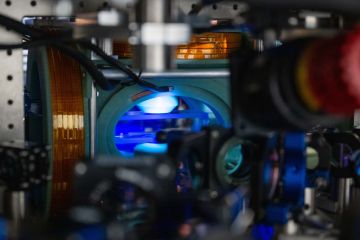
NSF researchers are chipping away at long-standing challenges in quantum computing, like error correction and scalability. In 2025, research groups at two NSF Physics Frontiers Centers made significant strides: One group created a new system that can detect and remove errors below a key performance threshold, a sign that practical error correction may finally be within reach. Another group created a record-setting array of 6,100 neutral-atom qubits held in a grid by lasers. They even moved these atoms across the grid while maintaining superposition, a key capability that makes neutral-atom systems especially promising for efficient error correction. Together, these advances bring practical, powerful quantum computers closer to reality.
Taking quantum into the future
Today, NSF continues to drive the field forward through a range of programs. The NSF Quantum Leap Challenge Institutes, established in 2020, fund large, collaborative projects to develop the essential components and functional pieces needed for reliable, scalable quantum computers, while training the next generation of quantum scientists and engineers. The NSF National Quantum Virtual Laboratory is designing prototypes of future quantum infrastructure to give researchers across the country access to cutting-edge quantum hardware, software and algorithms, making it easier to test ideas and turn discoveries into technology.
NSF boosts early-stage innovation through America's Seed Fund, supporting startups that are building everything from new qubit technologies to software and hardware subsystems. At the same time, NSF fosters partnerships across universities, government labs, and industry to push forward hybrid classical-quantum systems, improve error correction, and explore emerging applications in artificial intelligence, cryptography, biotechnology and beyond.
From theory to application, NSF's continued investments are enabling new methods, hardware and software with unparalleled capabilities. These breakthroughs are laying the groundwork for a future where quantum computers can help us seize enormous opportunities — revolutionizing scientific discoveries, fortifying national security and strengthening economic competitiveness.
Delve deeper: Learn more about NSF's history of investments in quantum.
Additional resources
- "Advances in Quantum Computing" | Podcast
An NSF Discovery Files podcast exploring quantum computing and advances in the field - Software-Tailored Architectures for Quantum Co-design
A multi-institutional research program that designs and tests quantum algorithms, creating foundational advancements for future, more powerful quantum systems. - Enabling Practical-scale Quantum Computing
Bridging the gap between quantum hardware and real-world applications, making quantum computers more efficient and accessible. - NSF Engineering Research Center for Quantum Networks
This center develops key technologies for creating the first error-corrected local and global quantum networks, enabling nationwide access to quantum computing. - National Q-12 Education Partnership
Access a wide collection of quantum educational tools and course materials for teachers, students and families.