



NSF-supported researchers honored with 2026 Nobel Prizes
Four NSF-supported researchers are among the 2026 Nobel Prize laureates, recognized for breakthroughs that transformed neuroscience, created a new way to explore the universe, and improved understanding of economic stability
The bottom line
- Karl Deisseroth, Peter Hegemann, and Georg Nagel, physiology or medicine — Pioneered optogenetics, a technique that uses light-sensitive proteins to control nerve-cell activity and investigate brain function. NSF supported Deisseroth's research advancing optogenetic tools.
- Francis Halzen, physics — For major contributions to the NSF IceCube Neutrino Observatory and its discoveries of elusive neutrino particles. NSF invested in the design, construction, and ongoing operations of NSF IceCube, which has enabled greater understanding of astrophysical neutrinos and their origins.
- Robert E. Hall and Michael Woodford, Nobel Memorial Prize in Economic Sciences — Developed economic models explaining how the decisions of households and businesses influence economic fluctuations, helping improve policies to stabilize inflation, employment, and economic activity. NSF supported both laureates' research on economic fluctuations and stabilization policy.
From controlling brain cells with light to detecting "ghost particles" from distant galaxies and understanding economic fluctuations, the 2026 Nobel Prizes recognize discoveries that have transformed science and society. Four of this year's laureates received support from the U.S. National Science Foundation, bringing the total number of NSF-supported Nobel laureates to 278. Their achievements highlight how sustained investments in fundamental research, scientific infrastructure, and innovative ideas can lead to breakthroughs with far-reaching impacts, often decades after the initial research began.
Physiology or medicine
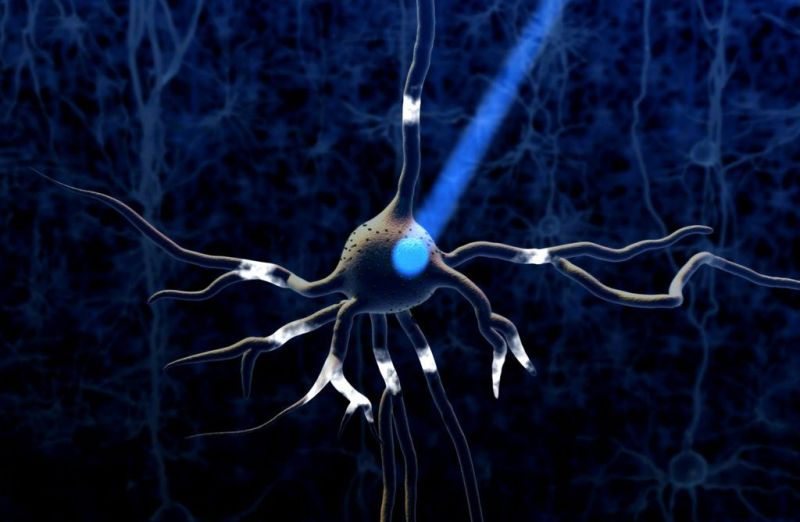
Karl Deisseroth, Peter Hegemann, and Georg Nagel — Optogenetics
Peter Hegemann and Georg Nagel discovered channelrhodopsin, a light-sensitive protein in algae, and Karl Deisseroth transformed the discovery into optogenetics, a technique that uses light to control neurons and other cells. Optogenetics has revolutionized neuroscience by allowing researchers to directly investigate how specific neural circuits shape memories, emotions, behaviors, and other brain functions.
NSF supported Deisseroth's development of technologies for studying neural circuits, including a 2007 award to develop tools using light-sensitive proteins to rapidly activate and inhibit neurons in living animals. NSF later supported him to design and implement novel methods to observe brain-wide cellular activity and to lead a $9.2 million NeuroNex Technology Hub that produced a suite of integrated tools to understand how neural circuits give rise to behavior and cognition.
These advances continue to provide new ways to investigate brain function and the mechanisms underlying neurological and psychiatric disorders. Optogenetics has been used to control other engineered cells, including Deisseroth's work to develop tools for synthesizing functional materials within living cells, which will enable future biomanufacturing.
Selected NSF awards
- Award 0724593 In vivo Technology for Fast Optical Control of Neural Circuits (2007) — Supported Deisseroth's development of technologies for controlling neural circuits with light.
- Award 1247950 INSPIRE: Fully-assembled Biology via Light-field Illumination and Intact-tissue Imaging (2012) — Awarded to Deisseroth to support tools for observing cellular activity across the brain in 3D and in real time.
- Award 1707261 NeuroNex Technology Hub (2017) — Supported Deisseroth's integration of genetics, optics, engineering, and computational technologies for observing and controlling neural circuits.
- Award 2037164 FMRG: Genetically-targeted chemical assembly (GTCA) of functional structures in living cells, tissues, and animals (2020) — Supported a collaboration between Deisseroth, Zehnan Bao, and Nobel Prize winner Carolyn Bertozzi to develop optogenetic methods to manipulate living cells for biomanufacturing.
Physics
Francis Halzen — "decisive contributions" to NSF IceCube Neutrino Observatory
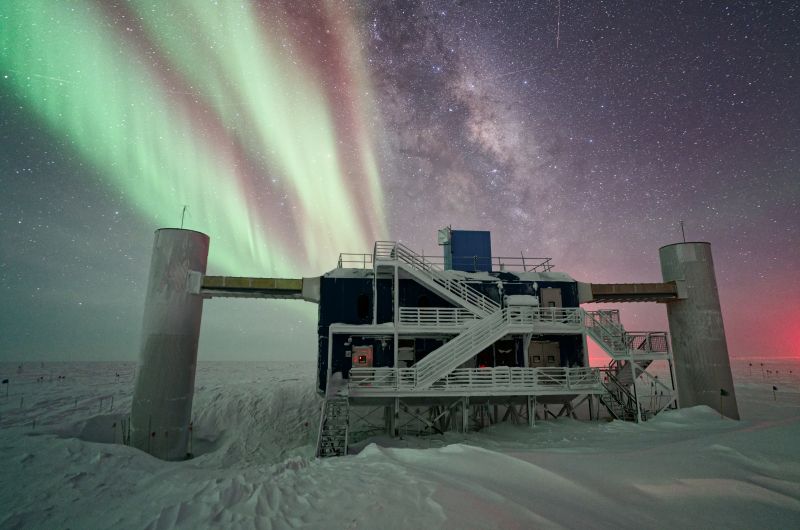
When it was first proposed to NSF in the 1990s, IceCube was an ambitious vision for a scientific facility unlike any other. Francis Halzen and other scientists devised a plan to place thousands of digital detectors more than two kilometers deep in the crystal-clear ice of the South Pole, an ideal location to spot neutrinos. Oftentimes called "ghost particles," neutrinos exist in great quantities but normally pass straight through Earth undetected. Just detecting a single neutrino is a daunting challenge, but IceCube was made to detect many and determine where they are coming from.
Over more than two decades, NSF invested in the design, construction, and ongoing operations of IceCube, which has enabled greater understanding of astrophysical neutrinos and their origins. IceCube's construction began in 2004 at the NSF Amundsen-Scott South Pole Station with support from the NSF-managed U.S. Antarctic Program. In 2011, IceCube began operations and, two years later, published findings showing it had detected the highest-energy neutrinos ever observed. The neutrinos had more than a million times the energy of those previously detected, which provided the first evidence that neutrinos might be regularly passing through Earth from distant high-energy sources outside the solar system.
In the years since, analysis of data produced by IceCube has resulted in many more discoveries and findings that have expanded human understanding of the nature of the universe. Those findings include definitive evidence in 2018 of neutrinos coming from a supermassive black hole in another galaxy. And in 2023, IceCube produced the first-ever neutrino-based image of the Milky Way. Many of these results were made possible by NSF high-performance computing facilities that scientists used to crunch vast amounts of data from IceCube and run simulations that helped them interpret the measurements with greater accuracy.
NSF continues to support IceCube, including a major upgrade completed in 2026. Researchers continue to use this unique facility to test and develop new theories and to combine neutrino detections with observations of light, gravitational waves, and other cosmic signals to understand the nature of the universe.
Economic sciences
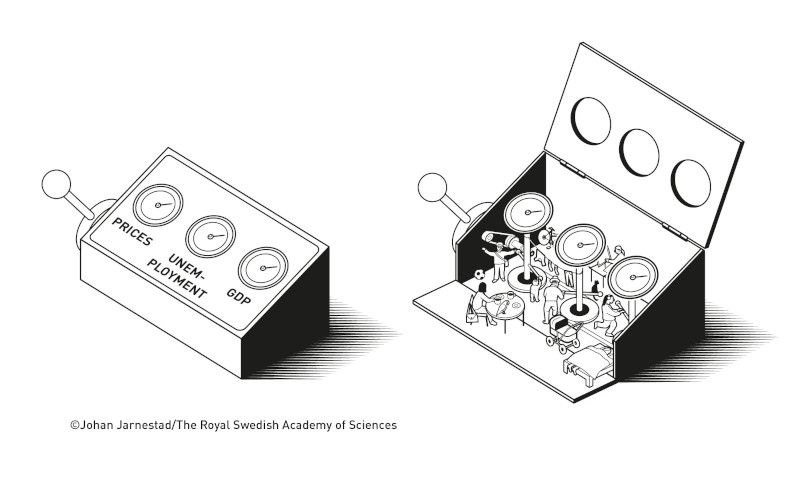
Robert E. Hall and Michael Woodford — Macroeconomic stabilization
Robert E. Hall and Michael Woodford developed economic models that explain how the decisions of individual households and businesses influence the broader economy. Their work helped address limitations in earlier models that struggled to explain periods of high inflation, unemployment, and slow economic growth. By accounting for how people and businesses respond to changing economic conditions and expectations about the future, the laureates strengthened economists' understanding of what drives recessions and how governments and central banks can respond. Their research helped establish the foundations for modern economic models used to guide monetary and fiscal policies, including adjustments to interest rates and government spending aimed at reducing economic fluctuations.
NSF supported both laureates' research over several decades. Hall investigated the underlying causes of economic fluctuations, including how changes in market demand, productivity, and business decisions affect employment and economic activity. Woodford developed models examining how interest rates, inflation, and expectations about future economic conditions influence the effectiveness of monetary policy. Their work continues to inform research on how economies respond to unexpected disruptions, including energy price shocks and changes in consumer spending, and how policymakers can better anticipate and manage economic instability.
Selected NSF awards
- Award 7824637 — Project on Inflation (1979) — Supported Hall's research incorporating household consumption decisions into broader economic models to better understand economic activity and fluctuations.
- Award 8207647 — Economic Stagnation and Long-Term Relations (1982) — Supported Hall's research using household consumption data to test economic theories and improve models of economic fluctuations.
- Award 9809469 — Monetary Policy, Inflation Stabilization, and Welfare (1998) — Supported Woodford's development of economic models examining how interest rate policies influence inflation, economic activity, and household well-being.
- Award 0422403 — Collaborative Research: Optimal Rules for Monetary and Fiscal Policy (2004) — Supported Woodford's research on designing monetary and fiscal policies that respond to economic disruptions while promoting stability and economic well-being.
- NSF Graduate Research Fellowships (1966 and 1980) — Robert E. Hall (1966) and Michael Woodford (1980) received NSF Graduate Research Fellowships, which support promising graduate students pursuing advanced research. These fellowships provided early-career support to both economists before their Nobel Prize-winning contributions to macroeconomics and monetary policy.
With this year's honorees, 278 Nobel laureates have received NSF support, reflecting the agency's longstanding commitment to fundamental research across scientific disciplines. This includes 83 laureates in physics, 70 in chemistry, 75 in economic sciences, and 50 in physiology or medicine. From supporting individual researchers and innovative ideas to sustaining large-scale scientific infrastructure, NSF investments have helped lay the groundwork for these and many other discoveries that have advanced science, improved quality of life, and strengthened national security.