



Critical minerals: The elements of innovation
These minerals are the backbone of the modern world, powering energy systems, defense technologies, advanced manufacturing, the digital economy, and breakthrough technological innovations.
The bottom line
- Critical minerals are resources like lithium, gallium, and rare earth elements that are in high demand and used to make many of the technologies people rely on every day.
- From smartphones and satellites to medical devices and defense systems, critical minerals underpin key industries, drive technological innovation, and support national security.
- For decades, the U.S. National Science Foundation has invested in the science behind critical minerals, enabling breakthroughs that strengthen U.S. supply chains and industrial capacity.
What are critical minerals?
Critical minerals are naturally occurring elements, minerals, and materials essential to U.S. economic prosperity and national security but are vulnerable to global supply disruptions and difficult to replace.

Whether a mineral is considered critical can change with time as technologies advance, industries evolve, and global supply chains shift. This means a mineral considered critical today may not be in the future, while others may emerge as increasingly vital.
Using the criteria established by the "Energy Act of 2020," the U.S. Geological Survey identified 60 critical mineral commodities in 2025, such as copper, neodymium, aluminum, uranium, cobalt, silver, and platinum group elements.
Why are critical minerals important?
Critical minerals are the raw materials and catalysts needed to produce the technologies and products we rely on every day. For example:
- Smartphones and computers: Tantalum helps capacitors manage electrical current, indium enables touchscreens, and rare earths are used in speakers and vibrant displays.
- Semiconductors and microchips: Silicon, gallium, and germanium are used to make computer chips and other high-performance microelectronics.
- Batteries and energy storage: Lithium, cobalt, nickel, and graphite are key components of rechargeable batteries used in everything from electronics to grid-scale storage.
- Medical technologies: Titanium gives artificial joints strength and durability, platinum supports pacemaker function, and rare earths power high-strength magnets in MRI scanners.
- Fertilizers: Phosphate and potash supply essential nutrients for plant growth and increase global crop yields.
- Defense and aerospace technologies: Aluminum keeps aircraft frames lightweight, rhenium fortifies heat-resistant engines, and rare earths support precision guidance systems and advanced radar sensors.
NSF's investments in critical minerals
For over 75 years, NSF has invested in the science, tools, and talent behind critical minerals, supporting foundational research in geosciences, chemistry, engineering, and materials science. This includes:
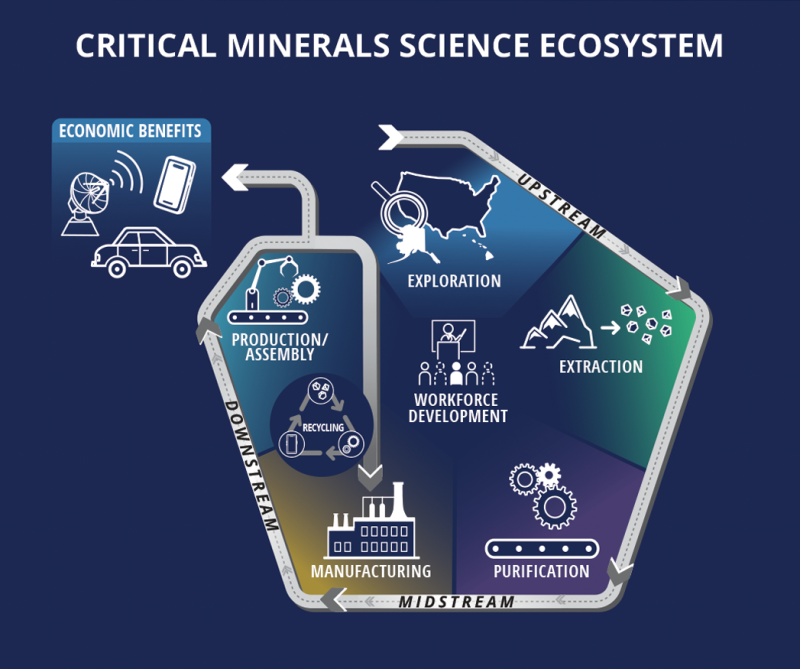
- Locating mineral sources: Over decades, NSF-supported research has deepened understanding of where critical minerals are found, how deposits form, and which geological processes influence their distribution. This long-term effort has helped shape modern mineral exploration strategies and improved resource management.
- Recovery and purification: Through sustained investment in separation technologies, including physical, chemical, electrochemical, and biological methods, NSF has continually enhanced the efficiency, selectivity, and versatility of critical mineral recovery. These innovations have enabled the extraction and purification of valuable elements from both ore deposits and secondary waste streams (e.g., mining tailings, wastewater, electronic scrap) and have supported the refinement of high-quality materials essential for modern technology.
- Reducing reliance: NSF-backed research has explored earth-abundant materials, catalysis, substitution chemistry, and advanced manufacturing, yielding viable alternatives for rare earth elements in batteries and magnets that help reduce supply risks while meeting industrial performance demands. Learn more about NSF investments in materials science.
NSF has also supported generations of scientists, engineers, and technical workers across all career stages. Undergraduate research, graduate fellowships, and programs such as Advanced Technical Education give students opportunities to build foundational knowledge and specialized skills, from analyzing crystal chemistry or tectonic structures to locate economic deposits to hands-on training in critical mineral processing, extraction, and recycling technologies. Beyond academia, NSF-supported internships and university-industry partnerships have provided students and researchers with the chance to work alongside mining and industry professionals, gaining practical experience tailored to current industry standards and technical hiring needs.
What opportunities remain?
Demand is increasing, while many critical mineral resources are difficult or expensive to locate, recover, and process.
Meeting that demand will require:
- Finding new sources beyond conventional mining, including wastewater, industrial runoff, geothermal fluids, and mining waste.
- Improving recovery and separation methods so critical minerals can be extracted more efficiently from ores, waste streams, and other materials. This is especially important for rare earth elements, which can be difficult and costly to separate but are essential to technologies such as permanent magnets and electronics.
- Improving recycling so more critical minerals can be recovered from products already in circulation, including discarded electronics.
Taking critical mineral research into the future
From emerging technologies to regional innovation, NSF investments are expanding how researchers discover, understand, and develop critical mineral resources. Projects are revealing how rare earth elements become concentrated in deeply weathered rocks in Georgia's Coastal Plain and how magma evolution and ancient fault systems shaped the Colorado Mineral Belt and Arizona's copper mining district, which may point to promising new exploration targets. In Oklahoma, NSF funding is supporting the development of novel technologies to recover critical minerals from mature shale reservoirs using existing oil and gas infrastructure.
NSF researchers are also exploring new pathways across the mineral life cycle — such as developing a new cobalt mine in Idaho; recovering antimony, nickel, and other critical elements from existing mining operations; and extracting valuable materials from mine waste and industrial wastewater. Other projects, like OneMineralogy, are expanding the world's largest global mineral database and building new analytical tools to accelerate super intelligence-driven discoveries, support mineral exploration and strengthen science education.

NSF also supports research infrastructure that brings together universities, industry and regional partners to cultivate a skilled workforce and address critical mineral needs. For example, the NSF Industry-University Cooperative Research Centers (NSF IUCRC) are advancing geoscience data use in the mining industry and developing methods to recover and recycle critical minerals from electronic waste. Through the NSF Regional Innovation Engines (NSF Engines) initiative, NSF is expanding the domestic supply of critical minerals and materials by supporting new mineral development in Alaska, resource recovery in the Great Lakes, and enhancing materials production in Kansas City. Other NSF efforts, such as the Tech Metal Transformation Challenge, are helping to accelerate breakthrough technologies that will strengthen the U.S. supply chain for critical and strategic metals that power America's energy, defense, and manufacturing future.
As technologies evolve and resource needs continue to change, NSF's sustained investments are helping build the knowledge, capabilities, and talent needed to keep the United States at the forefront of discovery, strengthen domestic supply chains, and support long-term economic competitiveness and national resilience.
Additional Resources:
- "Increasing Domestic Critical Minerals Supplies" | Podcast
An "NSF's Discovery Files" podcast episode discussing the recovery of critical minerals from the byproducts of existing mining sites. - Critical Minerals Booklet
NSF's educational guide to studying, using, and finding critical minerals. - Center for Resource Recovery and Recycling
This NSF IUCRC advances technologies that recover, recycle, and reuse materials throughout the manufacturing process. - Center to Advance the Science of Exploration to Reclamation in Mining
This NSF IUCRC applies advanced geoscience data and engineering approaches to improve mining from exploration through reclamation. - NSF Critical Mineral Accelerator Engine in Alaska
This NSF Engine combines advanced mining, processing, and purification technologies to unlock Alaska's mineral potential. - NSF Great Lakes RENEW Engine
This NSF Engine works to recover critical resources and eliminate harmful contaminants from water. - NSF Critical Materials Crossroads Engine in Kansas City
This NSF Engine is building a domestic critical minerals supply chain and reinforcing U.S. manufacturing strength.