



NSF in 2025: Keeping U.S. scientific research and innovation on the cutting edge
Leadership in AI, quantum and other areas critical to America's future prosperity and security
For 75 years, the U.S. National Science Foundation has helped secure the nation's leadership in science and engineering — and the prosperity, national security and economic competitiveness that depend on it.
NSF investments in 2025 focused on critical technology areas such as artificial intelligence, quantum, semiconductors and advanced manufacturing. As NSF embarks on a new era while continuing to support research across all scientific disciplines, these investments will establish the strong foundation of research and innovation that keeps the nation at the forefront of global innovation throughout the 21st century.
Supporting innovative research that propels U.S. leadership in critical areas
Accelerating scientific discovery with AI
In 2025, NSF strengthened U.S. leadership in AI through its National Artificial Intelligence Research Resource (NAIRR) and National Artificial Intelligence Research Institutes program.
Through the NSF-led NAIRR pilot, more than 600 research teams are now connected to a shared national AI infrastructure, gaining access to advanced tools, data, training and expertise. NSF also initiated efforts to establish a NAIRR Operations Center, which will guide the transition of NAIRR from a pilot into a coordinated national program.
The agency also expanded its AI Research Institutes program with a $100 million investment in partnership with industry leaders, supporting research in AI literacy, human-AI collaboration, materials discovery, drug development and science, technology, engineering and mathematics education. This effort strengthens a nationwide network of institutes focused on high-impact AI research. Other NSF-led AI programs complement these investments, including:
- Up to $100 million for NSF Test Bed: Toward a Network of Programmable Cloud Laboratories, establishing AI-enabled labs to integrate, test, evaluate and validate cutting-edge AI technologies.
- $75 million from NSF for Open Multimodal AI Infrastructure to Accelerate Science to develop an open suite of powerful AI models for the U.S. scientific community.
- $20 million to expand the NSF CloudBank, increasing access to commercial cloud computing, AI models and other state-of-the-art cloud services.
Together, these investments helped chart a decisive course to cement U.S. dominance in artificial intelligence through strengthened U.S. leadership in AI. NSF's support of the Trump Administration's AI Action Plan and the goals of the Genesis Mission, helps accelerate scientific discovery, ensuring the U.S. remains at the forefront of AI research, education and innovation.
Harnessing the quantum-scale universe
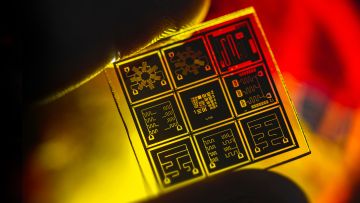
In 2025, NSF-supported teams achieved major milestones: one built the largest quantum bit array ever recorded — 6,100 neutral-atom quantum bits trapped and controlled by lasers — while another integrated all the key elements for scalable, error-corrected quantum computation. These breakthroughs bring practical quantum computing closer to reality, promising computing speeds far beyond today's supercomputers, ultra-secure communications and new materials that could transform medicine and industry.
NSF also selected the first four teams to design infrastructure for the NSF National Quantum Virtual Laboratory, which will provide researchers nationwide with access to cutting-edge quantum hardware and software, making it easier to test ideas and turn discoveries into practical technologies. In partnership with U.K. Research and Innovation, NSF is exploring how quantum information affects chemical reactions and molecular systems, paving the way for breakthroughs in computing, ultra-precise navigation and secure communications.
Fueling innovation and economic growth through partnerships
NSF supports partnerships across government, academia and industry in critical areas like semiconductors, advanced manufacturing and next-generation communications.
In 2025, NSF named 15 finalists for the second competition under the Regional Innovation Engines (NSF Engines) program, funding projects that span energy-grid security, quantum computing and critical mineral extraction. A $135 million initial NSF Engines investment has already leveraged more than $1 billion in matching commitments, accelerating technologies that keep the U.S. globally competitive in AI, chipmaking, quantum science, energy storage and disaster preparedness.
NSF is also investing over $74 million in six Mathematical Sciences Research Institutes, catalyzing research that tackles today's challenges and prepares for tomorrow's breakthroughs — from improving patient care in hospital emergency rooms to detecting exoplanets using quantum physics. Past work at these institutes has improved MRI imaging speed and accuracy and established the mathematical foundations for AI technologies.
The newly launched NSF Verticals-enabling Intelligent NEtwork Systems (VINES) program will invest up to $100 million to build next-generation wireless networks in partnerships with industry and collaborators, unlocking efficiencies and new capabilities in advanced manufacturing, precision agriculture, remote health care, critical infrastructure and smart grids.
Finally, NSF announced a new initiative designed to launch and scale a new generation of independent research organizations that will focus on technical challenges and bottlenecks that traditional university and industry labs cannot easily solve on their own. The Tech Labs initiative will support teams of researchers, scientists and engineers who will pursue technical breakthroughs that have the potential to reshape or create entire technology sectors. Input from academia, policymakers, nonprofits, philanthropy, state and local government, venture capital, the private sector and any other interested parties will shape the initiative. NSF anticipates significant investment later in FY 2026, featuring large, multi-year awards for selected teams.
Training tomorrow's scientific workforce
One of NSF's most successful, longstanding efforts to expand research capacity and talent development across all parts of the nation is the NSF Established Program to Stimulate Competitive Research (NSF EPSCoR). In 2025, the agency invested more than $65 million through NSF EPSCoR to strengthen research infrastructure and prepare the next-generation workforce. These investments include:
- Supporting institutions across Montana, Idaho and Louisiana to establish NSF EPSCoR Centers of Research Excellence in Science and Technology. These centers will expand knowledge, enhance research productivity and attract students into STEM fields.
- Six major awards across 11 jurisdictions through the EPSCoR Research Infrastructure Improvement Program that will strengthen research capacity and drive translational research. These four-year grants support research by organizations in Alabama, Idaho, Kansas, Nebraska, Oklahoma, South Dakota and other states and span areas such as functionality of electronic devices, biotechnology and AI-driven health care.
- Funding early- and mid-career scientists through the EPSCoR Research Fellows program, enabling projects in advanced and semiconductor manufacturing, AI, quantum and biotechnology — research that creates jobs, strengthens local economies and fuels U.S. innovation.
Additional efforts included expanding K-12 AI education, funding graduate traineeships in AI, quantum, biotechnology and translational science; and teaching semiconductor manufacturing skills to high school and community college students through AI-powered virtual reality.
Building the research infrastructure of the future
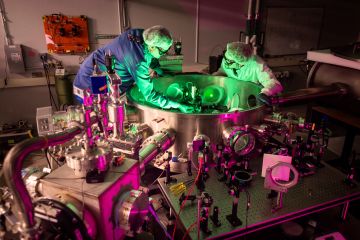
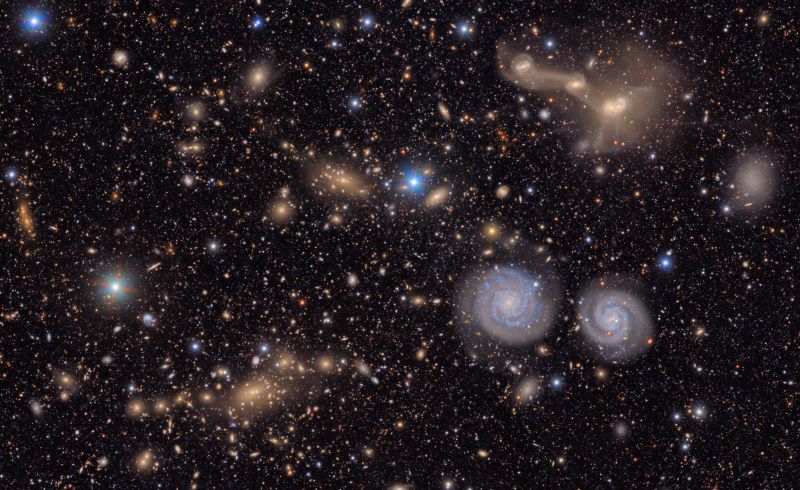
Alongside ZEUS, the NSF-DOE Vera C. Rubin Observatory reached a historic milestone by capturing its first images in just hours of test observations. Millions of galaxies and thousands of asteroids appeared in its view, previewing its upcoming 10-year survey that will collect more data in its first year than all previous optical observatories combined — fueling discoveries about dark matter, galaxy formation and planetary defense.
Supporting Nobel laureates
One of NSF's most impactful legacies is the number of Nobel laureates, across all scientific disciplines, who have been and will continue to be supported by the agency. In 2025, six additional researchers, who received NSF investments at different points in their careers, were honored with the Nobel Prize in their respective fields. This brings the total number of Nobel laureates supported by NSF to 274.
- Omar M. Yaghi shared the Nobel Prize in chemistry for developing metal-organic frameworks — molecular constructions that contain large spaces in which gases and other chemicals can be stored. These frameworks can be customized for specific applications, such as harvesting water from desert air, capturing carbon dioxide and storing toxic gases. To date, scientists have synthesized more than 100,000 distinct structures with different uses. NSF has supported Yaghi throughout his career, beginning in 1990 with a postdoctoral research fellowship and continuing today.
- John Clarke, Michel H. Devoret and John M. Martinis were honored with the Nobel Prize in physics for their discoveries that made it possible to observe and control quantum behavior — a subatomic phenomenon — in engineered electrical circuits big enough to be held in the hand. This allowed quantum mechanics to be directly observed and measured in the lab and led to the creation of superconducting qubits, the building blocks of quantum computers. Throughout their careers, all three laureates benefited from NSF support that advanced their research in superconductivity and quantum technologies.
- Joel Mokyr and Peter Howitt received the Nobel Prize in economics for explaining how technological innovation and the forces of creative destruction drive sustained growth, a key component of global economic growth since the Industrial Revolution. NSF supported Mokyr's research over four decades, and multiple NSF grants have funded Howitt's research.