





The U.S. National Science Foundation Directorate for Mathematical and Physical Sciences (NSF MPS) supports multiple materials research programs. These programs focus on advancing fundamental understanding of materials, their properties and their potential applications.
Materials serve as critical building blocks for new technologies and improvements to existing technologies. Advances in materials research are behind new types of electronics, batteries, medical devices, body armor, high-performance aerospace materials and other innovations. Materials research also enables new and emergent fields like artificial intelligence, biotechnology, quantum computers, quantum sensors and more.
The discovery and understanding of advanced materials enabled by NSF MPS programs are essential for the development of future technologies that strengthen national security, grow the U.S. economy and improve quality of life.
MPS programs also play a critical role in training students and early-career researchers across the U.S. who will become the next generation of materials researchers, technicians and other roles in the nation's science, technology, engineering and mathematics workforce.
 On this page
Materials research programs
MPS invests in multiple materials research programs supporting both theoretical and experimental research. The programs support individual researchers, small teams and interdisciplinary research spanning multiple programs.
Biomaterials
Supports research and education on biological, biomimetic, bioinspired and bioenabled materials and synthetic materials intended for applications where they will be in contact with biological systems.
Ceramics
Supports research and education on ceramics, glass-ceramics, inorganic glasses, ceramic-based composites and inorganic carbon-based materials to develop predictive capabilities for these materials.
Condensed Matter and Materials Theory
Supports fundamental theoretical research and education on hard and soft materials and related phenomena; development of associated analytical, computational and data-centric techniques; and predictive materials-specific theory, simulation and modeling.
Condensed Matter Physics
Supports research and education in the investigation of the fundamental physics underlying condensed matter systems, including both hard and soft matter.
Electronic and Photonic Materials
Supports research and education in developing advanced materials to enable transformative advances in electronics, optoelectronics and photonics for use in computing, communications and sensing.
Metals and Metallic Nanostructures
Supports research and education on the relationships between structure and properties of metals and their alloys.
Polymers
Supports research and education on the foundations of polymeric materials and polymer science, spanning the molecular level to the nanoscale and macroscale.
Solid State and Materials Chemistry
Supports research and education on organic, inorganic and hybrid materials, with an emphasis on materials synthesis and the relationships between material structure and properties.
Designing Materials to Revolutionize and Engineer Our Future
MPS supports and leads the cross-cutting Designing Materials to Revolutionize and Engineer Our Future program. The program includes multiple NSF directorates and other federal agencies and supports ambitious and collaborative research to rapidly and cost-effectively discover, develop and deploy advanced materials.

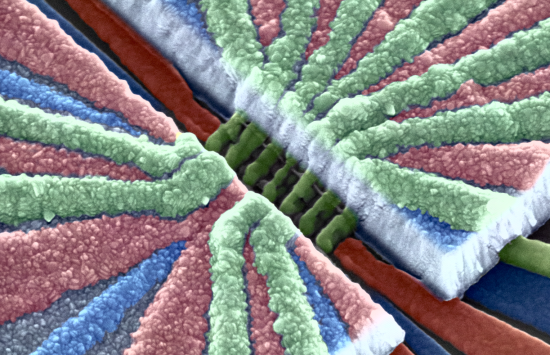
NSF Materials Research Science and Engineering Centers
The NSF Materials Research Science and Engineering Centers program supports research centers that provide the resources and interdisciplinary environment needed for materials research activities of ambitious scope and complexity. The centers have created many innovations, including plastics that conduct electricity, nanoparticle-based materials that harvest water from air, and superalloys that can withstand intense heat.
Additional resources
Subscribe to email updates from MPS
Get news on funding opportunities, upcoming events and research highlights.
Attend virtual office hours and webinars
Talk directly with MPS program directors and learn how to submit a proposal.
Find funding and contact a program director
Search for MPS programs and funding opportunities and find contact information.
Preparing your proposal
A guide with helpful tips on how to write and submit a research proposal to NSF.