




The U.S. National Science Foundation Directorate for Mathematical and Physical Sciences (NSF MPS) supports multiple research programs at the frontiers of discovery in physics. Physics research supported by NSF MPS enables human understanding of the fundamental aspects of nature at all scales, from the quantum effects inside atoms to the physical functions of cells and living systems to the mysterious dark energy spanning the entire universe.
Physics research probes the properties of matter and energy at the most basic level. Breakthroughs in physics have broad impacts on other fields of science and society as a whole, including enabling new technologies like artificial intelligence, GPS, MRI and quantum computers and sensors.
Fundamental physics research supported by NSF MPS lays the essential groundwork for future technologies that can improve health and quality of life, strengthen national security and create new economic opportunities for America.
MPS programs also prioritize education and workforce development by supporting training opportunities in labs and facilities across the U.S. These opportunities allow more students and early-career researchers to get involved with cutting-edge physics research and become part of America's STEM workforce.
 On this page
Physics research programs
NSF MPS physics programs support multiple types of research, including theoretical, experimental, computational and observational studies. The programs support individual researchers, small teams and cross-cutting interdisciplinary research spanning multiple programs.
Atomic, Molecular and Optical Physics - Experiment
Supports experimental research on the fundamental quantitative understanding of atoms and molecules, their interactions with each other and their interaction with light, and the application of AMO methods to fundamental science in other areas of physics.
Atomic, Molecular and Optical Physics - Theory
Supports theoretical and computational studies of atomic and molecular structure; atomic and molecular interactions, including collisions and photoionization/photodetachment; quantum optics; quantum information and ultracold phenomena in Bose and Fermi gases.
Elementary Particle Physics - Experiment
Supports laboratory research that explores the fundamental building blocks of matter and their forces by probing, directly or indirectly, particle interactions.
Elementary Particle Physics, Astrophysics and Cosmology - Theory
Supports research in theoretical high-energy physics, including collider physics, supersymmetry, extra space-time dimensions, unification and string theory. Also supports theoretical cosmology, including Big Bang cosmology and new ideas from particle physics.
Gravitational Physics
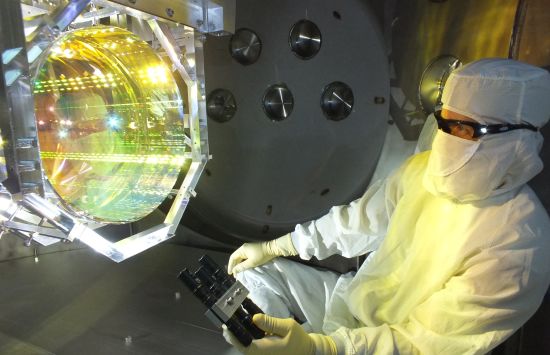
Supports gravitation research and infrastructure, including data analysis for gravitational-wave detectors, instrumentation development and characterization at NSF LIGO, and foundational research in classical and quantum gravity theory.
Integrative Activities in Physics
Supports interdisciplinary physics research; research experiences for undergraduates in physics; and education and training of undergraduate and graduate physics students, especially associated with large physics facilities.
Nuclear Physics - Experiment
Supports experimental research at the frontiers of nuclear physics in the following areas: nuclear astrophysics, structure and reactions; nuclear and hadron quantum chromodynamics; precision measurements of fundamental symmetries and constants.
Nuclear Physics - Theory
Supports research on fundamental theoretical aspects of nuclear physics, model building and applications to astrophysical phenomena and experimental programs at particle accelerator facilities.
Particle Astrophysics - Experiment
Supports research on the fundamental nature of matter, energy, space and time in the following areas: cosmic phenomena, underground physics and IceCube research support.
Physics of Living Systems
Supports theoretical and experimental research that explores the fundamental physical processes used by living systems, with a focus on basic physical principles that underlie biological function.
Plasma Physics
Supports foundational research in plasma physics including study of magnetized plasmas, high-energy-density plasmas, low temperature plasmas, strongly coupled plasmas, non-neutral plasmas, and intense field-matter interaction in plasmas.
Quantum Information Science
Supports theoretical and experimental physics research towards foundational understanding of quantum information science and technologies. Supported work may be synergistic with other areas such as mathematics and computer science.
MPS also supports the following cross-cutting physics research programs:
Advanced Physics Instrumentation
Supports the acquisition, development and/or implementation of the advanced instrumentation needed for NSF MPS physics research programs.
Focused Research Hubs in Theoretical Physics
Supports teams to advance cutting-edge foundational research in theoretical physics, enhance the impact of the field and foster the development of the next generation of scientists in theoretical physics.
Physics at the Information Frontier
Supports the development of science-driven cyberinfrastructure through advances focused on the convergence of big data and high-performance computing and algorithm development.
NSF Physics Frontiers Centers
The NSF Physics Frontiers Centers bring together large teams of researchers to produce boundary-breaking results. Such work requires years of concentrated effort, a range of scientific and technical expertise and new types of equipment. The centers have produced a wide range of major discoveries, including the first evidence of the gravitational wave background of the universe and the atomic-scale mechanism some viruses use to infect human cells.
Additional resources
Subscribe to email updates from MPS
Get news on funding opportunities, upcoming events and research highlights.
Attend virtual office hours and webinars
Talk directly with MPS program directors and learn how to submit a proposal.
Find funding and contact a program director
Search for MPS programs and funding opportunities and find contact information.
Preparing your proposal
A guide with helpful tips on how to write and submit a research proposal to NSF.